Follow the Money: From an Intelligence-Funded Start to Billions in Stock Sales
The Karp Files, Part 2: how Palantir got into the federal budget, how its founders kept control, and what Alex Karp has taken out, measured against a Marine general who called war “a racket.”


Karp in Brief
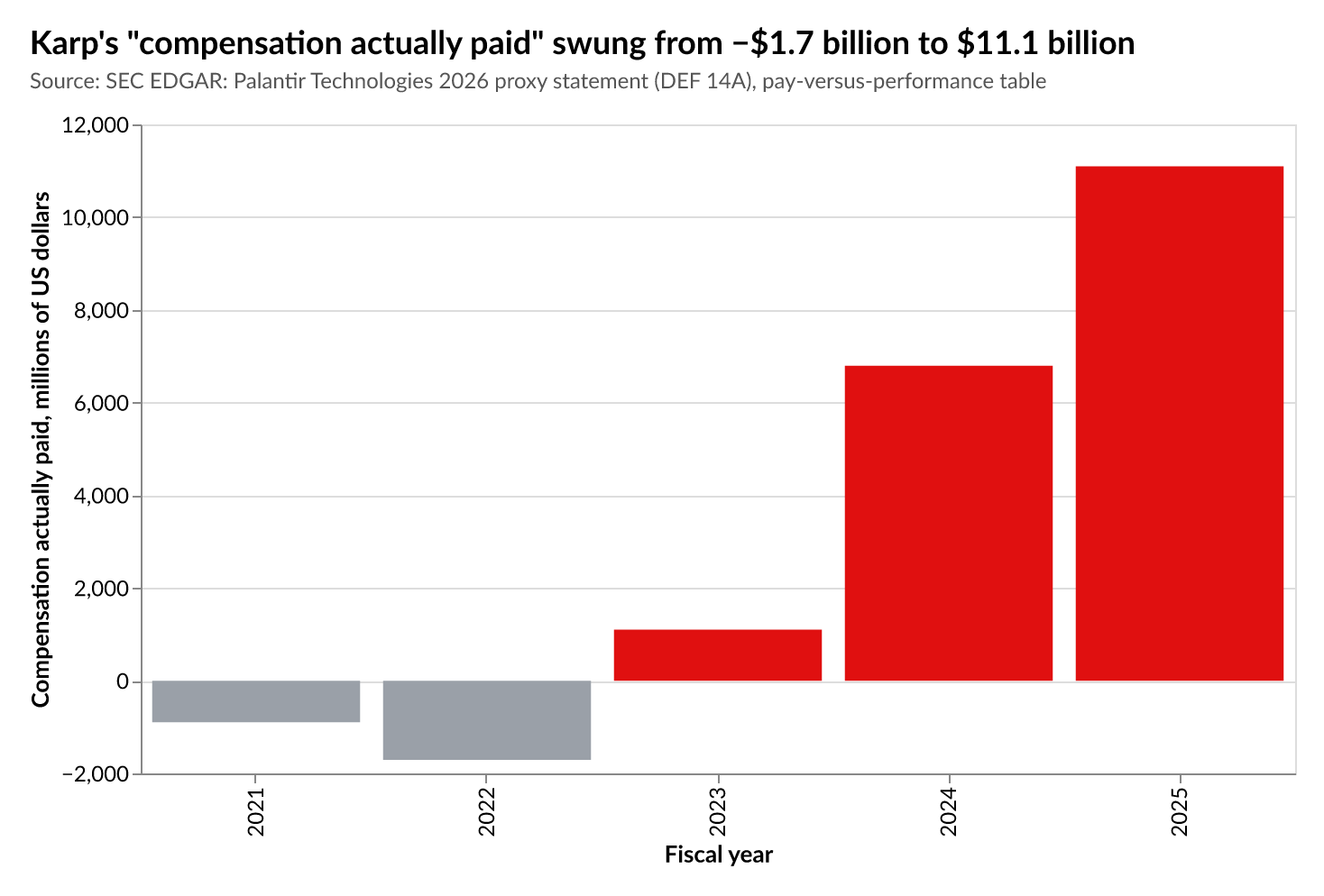
Palantir’s 2026 proxy lists two numbers for Alex Karp’s 2025 pay: $8.6 million in standard pay, and $11.1 billion in “compensation actually paid,” which tracks the stock price and isn’t cash [1].
By my count of his SEC Form 4 filings, Karp has sold about $3.49 billion in Palantir stock since 2020, in gross proceeds; the filings mark about $521 million of that as automatic sales to cover taxes when his stock awards vested (full tally).
Palantir long said its ICE work stayed out of the deportation branch; in April 2026, ICE signed an $86.3 million Palantir order for “Enforcement Removal Operations modernization” [17][34].
Palantir’s 2026 proxy statement, the annual disclosure a public company sends shareholders before its meeting, contains two numbers for what Alex Karp was paid in 2025. One is $8.6 million. The other is $11.1 billion [1] (2026 proxy statement).
Both are correct. The first is the “summary compensation” figure: salary, perks and the value of any new stock awards on the day they were granted [1] (2026 proxy statement). The second is “compensation actually paid,” a measure the Securities and Exchange Commission adopted in 2022 [5] and has required in proxy statements since 2023 [1]. It revalues every award an executive still holds at the price the stock closed the year, so it rises and falls with the stock [1]. By that measure, Karp topped the list of 104 chief executives that the analytics firm Stratrix compiled from proxy filings, ahead of Elon Musk’s $10.4 billion [1].
Palantir itself insists the bigger number isn’t a paycheck. A footnote in its 2026 proxy says the term “does not reflect the amount of compensation actually paid, earned or received by him during the applicable year” (2026 proxy statement). Still, Karp did turn a lot of that paper into cash, and he did it by selling stock in a company that was built on government work and lost money for most of its life.
This is Part 2 of The Karp Files. Part 1 covered where Karp came from and what he believes. This part follows the money.
In Karp’s words
Karp’s case for Palantir has always been that it is a different kind of tech company. In the 2020 letter that opened its stock-market prospectus, he wrote: “From the start, we have repeatedly turned down opportunities to sell, collect, or mine data. Other technology companies, including some of the largest in the world, have built their entire businesses on doing just that” [14] (S-1).
He has also been plain that serving government is good business. At the World Economic Forum in Davos in 2023, according to the forum’s transcript, he told the Carlyle Group’s David Rubenstein that In-Q-Tel’s “really small” investment came with pilot projects, and that a classified Defense Department unit was what “really got us off the ground,” because, he said, that unit was struggling to find where terrorists were planting improvised explosives (WEF transcript). On the Nov. 2, 2026, earnings call, describing what he called Palantir’s mission of supporting the war fighter, he put it more bluntly: “We are delighted that we can support the war fighter even more because we’re making so much money” [24] (Q3 2026 call transcript).
The money trail runs between those two ideas: a company that refuses to sell data, and one that profits from the security state.
Seed money from an intelligence-funded venture firm
Palantir was founded in 2003 by Karp, Peter Thiel and others, and it raised money from an arm of the Central Intelligence Agency, as the Philadelphia Inquirer put it [9]. That backer was In-Q-Tel, a venture firm funded by U.S. intelligence agencies, which, according to Global Venturing, put $2 million into Palantir’s Series A round [11].
Palantir’s final 2020 prospectus showed who owned it before it listed. As of June 30, 2020, Japanese insurer Sompo Holdings owned 20.3% of the Class A shares, and entities affiliated with Thiel’s Founders Fund owned 12.7% of the Class B shares [12] (S-1/A).
Suing its biggest customer
Palantir didn’t just win government work. It sued to change how the Army buys.
The U.S. Army’s intelligence system, the Distributed Common Ground System, or DCGS-A, had been built the traditional way: a custom “developmental” program that ran nearly two decades, cost more than $6 billion and drew heavy criticism from Congress [13]. When the Army planned the second version, Palantir pushed it to buy Gotham, Palantir’s existing commercial software, instead [13]. The Army issued a solicitation for a developmental system anyway. Palantir protested to the Government Accountability Office, which denied the protest in May 2016, and then sued in the Court of Federal Claims [13] (Federal Circuit opinion).
The court found that the Army had failed to meet its obligation under the Federal Acquisition Streamlining Act, which requires agencies to acquire commercial items “to the maximum extent practicable,” and it permanently blocked any award under the solicitation [13]. The Federal Circuit appeals court affirmed in September 2018, and was just as careful: “To be clear, we are not suggesting that the Army must choose Palantir as the awardee” (Federal Circuit opinion).
Control without a majority
When Palantir went public in September 2020, it chose a direct listing, in which existing shareholders sell straight to the market instead of the company issuing new shares, at a valuation of more than $15 billion [6]. It also created an unusual three-class stock structure. Class A shares get one vote. Class B shares get 10. And a special Class F, held in a voting trust for Thiel, Karp and co-founder Stephen Cohen, carries a variable number of votes: enough that the founders’ bloc, together with their other shares covered by a voting agreement, controls up to 49.999999% of the voting power, as long as the founders keep a minimum ownership stake the company calls the “Ownership Threshold” (S-1; 2026 proxy statement).
TechCrunch, which reviewed a leaked draft of the filing, pointed out that this is technically not a majority [12]. In practice, the founders’ bloc needs only a sliver of other votes to carry any shareholder decision, even as the founders sell shares; the prospectus itself told investors that control would be concentrated with the founders “for the foreseeable future” (S-1).
Two decades of losses, then a profit machine
At its listing, Palantir had never turned a profit; its filing said it had “incurred losses each year since our inception.” It reported a 2019 net loss of $579.6 million on revenue of $742.6 million [9][14] (S-1). The filing also listed public criticism of its government work as a business risk [9][14].
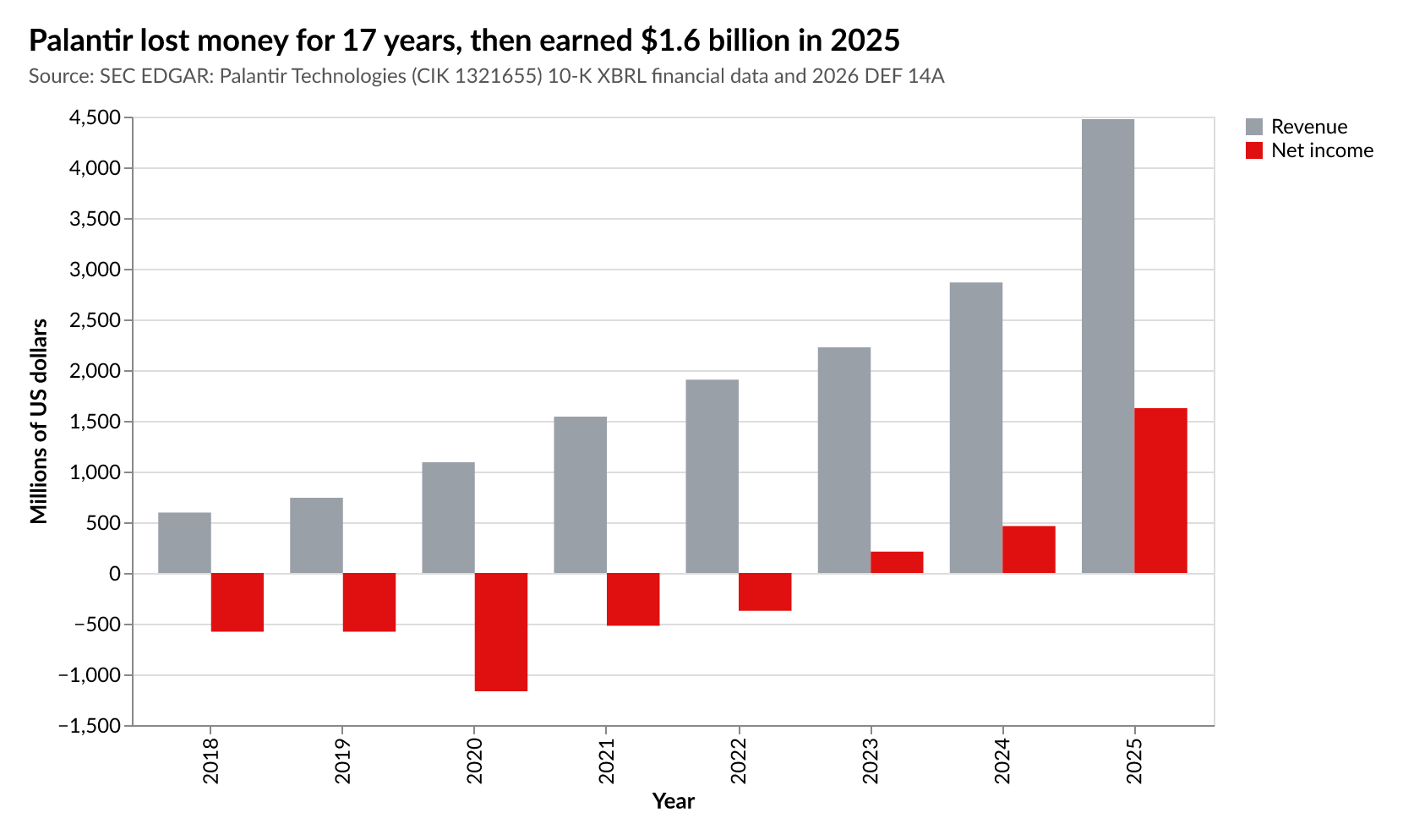
That changed fast. Palantir’s own SEC filings, charted above, show losses through 2022, its first annual profit in 2023, and $1.6 billion in net income in 2025. In the third quarter of 2026, revenue rose 96% from a year earlier to $2.313 billion, and net income attributable to shareholders more than doubled to $1.128 billion, from $475.6 million [15] (Q3 2026 release).
The same quarter marked a shift. For the first time, Palantir’s U.S. commercial revenue, $984 million, was larger than its U.S. government revenue, $953 million [15] (Q3 2026 release).
The contracts
Government money is still the backbone. A note on the numbers: a contract’s “ceiling” is the most it could ever pay, and money “obligated” is what the government has committed. Neither is money actually paid. The figures from the Federal Procurement Data System, the government’s official contract database, are obligations; the Maven and Army enterprise figures from news reports are ceilings, and are labeled that way.
Start with the Pentagon’s AI warfighting software. The Maven Smart System is Palantir’s AI platform for pulling together drone, satellite and sensor data for military operations; the Tech Transparency Project describes it as AI targeting technology [19][21]. The Pentagon awarded Palantir a $480 million, five-year contract for it in May 2024 and in May 2025 raised the ceiling by $795 million to nearly $1.3 billion, citing “growing demand” from combatant commands [19]. By then the system had more than 20,000 active users [19].
The Army added a separate Maven order in November 2025: W9128Z26FA001, issued under contract W519TC25D0039 rather than the May 2024 award. Its individual obligations add up to about $743 million as of Aug. 18, 2026 [18]. (The same record’s running total shows $1.18 billion; the two figures don’t reconcile, so I report the line-item sum.)
In July 2025 the Army also folded 75 contracts into a single 10-year enterprise agreement with Palantir, with a ceiling of up to $10 billion [20]. The contract record doesn’t say whether W519TC25D0039 is that agreement.
Immigration enforcement is the other pillar. ICE’s Homeland Security Investigations branch runs its Investigative Case Management system on Palantir. As of Sept. 16, 2026, the current case-management order, first awarded in September 2022, had $170.8 million obligated [16]. An April 11, 2025, modification added $29.9 million to “deploy new targeting and enforcement prioritization, self-deportation tracking, and immigration lifecycle process capabilities,” and a second $29.9 million modification on Sept. 25, 2025, covered “enhanced leads identification and targeting for enforcement, assisted voluntary return” [16].
Then there’s deportation. Palantir has long said its ICE work ran through Homeland Security Investigations, the agency’s investigative branch, not Enforcement and Removal Operations, the branch that carries out deportations. In 2019, a Palantir product manager drew that distinction publicly [34]. In February 2025, Fortune wrote that “Karp has said that Palantir does not work with the division of ICE that carries out deportations,” without saying when [7]. On April 30, 2026, ICE signed an $86.3 million order with Palantir for “Enforcement Removal Operations modernization and operational capability for the Enforcement Case Management System” [17].
Karp’s paycheck, and his stock sales
Karp’s real money comes from stock. Before the 2020 listing, Palantir gave him 141 million stock options and 39,000 restricted stock units, worth about $1.1 billion at the time, and he has received no new grants since [3] (2026 proxy statement).
Then the stock took off. Palantir shares rose 340% in 2024, the best performance in the S&P 500 [4]. That’s how a pay package valued at $1.1 billion when granted turned into $6.8 billion “actually paid” for 2024 and $11.1 billion for 2025 [1][4] (2026 proxy statement).
Karp has been selling. Sherwood News reported that he sold more than $2 billion worth of stock in 2024 alone [4]. Fortune, using data from the provider Washington Service, put his sales from the start of 2024 to February 2025 at 38 million shares worth $1.88 billion, with $1.4 billion of that from 25 million shares sold in the weeks around the 2024 presidential election [7]. Fortune reported that the sales were part of a 10b5-1 plan, a preset trading schedule that executives adopt in advance so trades happen without their day-to-day involvement [7].
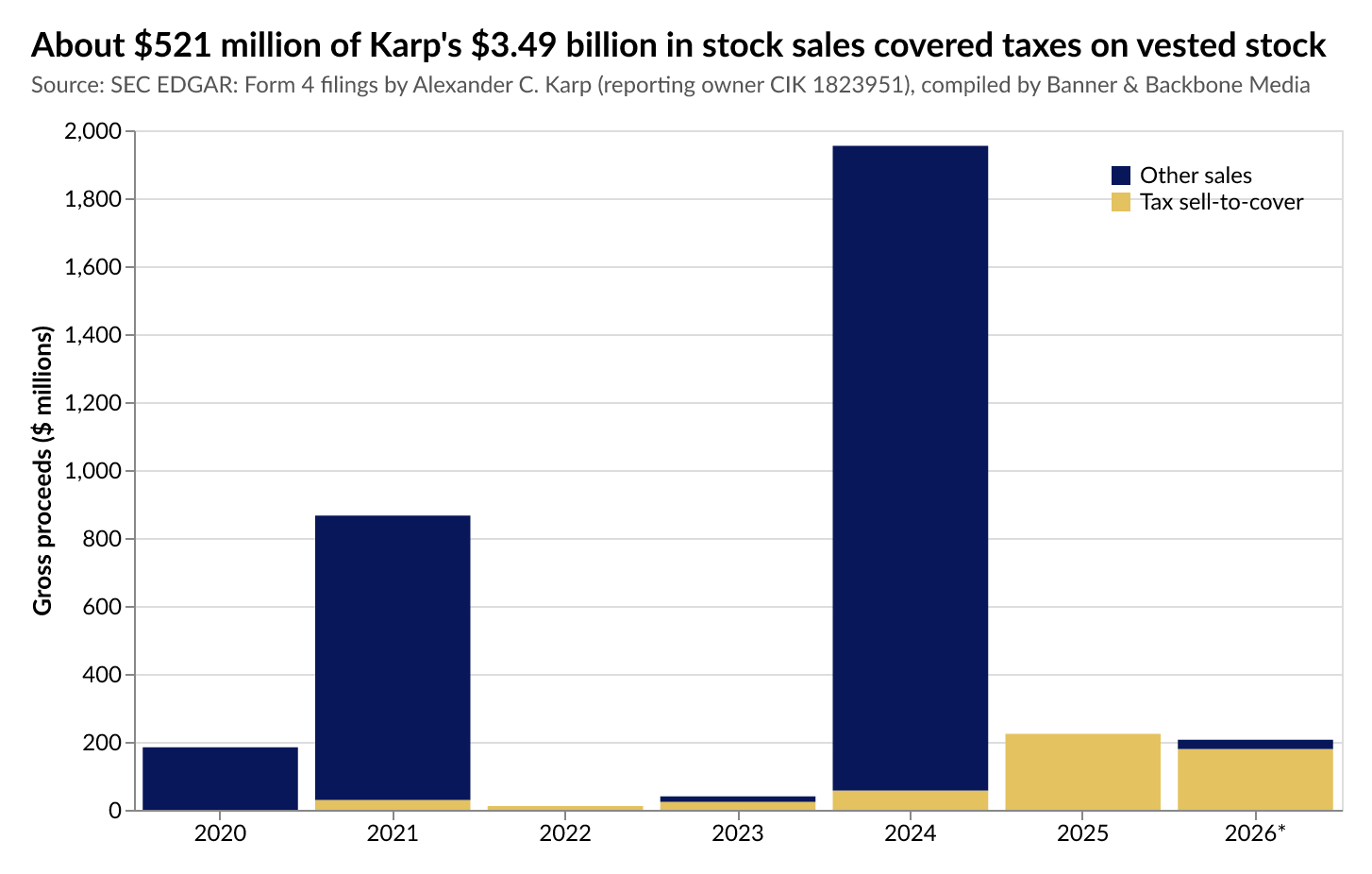
I added up every sale Karp reported on SEC Form 4, the form insiders file within two business days of a trade. Every sale, with a link to its filing, is in my public spreadsheet. I reviewed all 58 Form 4 filings he made from September 2020 through August 2026; 50 report sales, and together they total 100,981,437 shares and about $3.49 billion in gross proceeds, before taxes and fees. The filings’ own footnotes mark about $521 million of that as automatic sales to cover tax withholding when his restricted stock units vested. My 2024 figure, $1.95 billion, sits between Fortune’s $1.88 billion, which covers all of 2024 plus early 2025, and Sherwood’s “more than $2 billion” for 2024 [4][7]; I can’t tell from their reporting which transactions each count includes.
Palantir’s annual report for 2025 discloses a plan letting Karp sell up to 360,000 more Class A shares through November 2026 [8] (2025 10-K).
The perks are smaller but telling. Under the standard pay table, most of Karp’s 2024 pay beyond his $1.1 million cash came from security and travel benefits [3]. Fortune reported that the 10-K disclosed $17.2 million in executive aircraft expenses for Karp in 2025, up from $7.7 million in 2024, covering both business and personal travel [8] (2025 10-K).
Buying a seat at the table
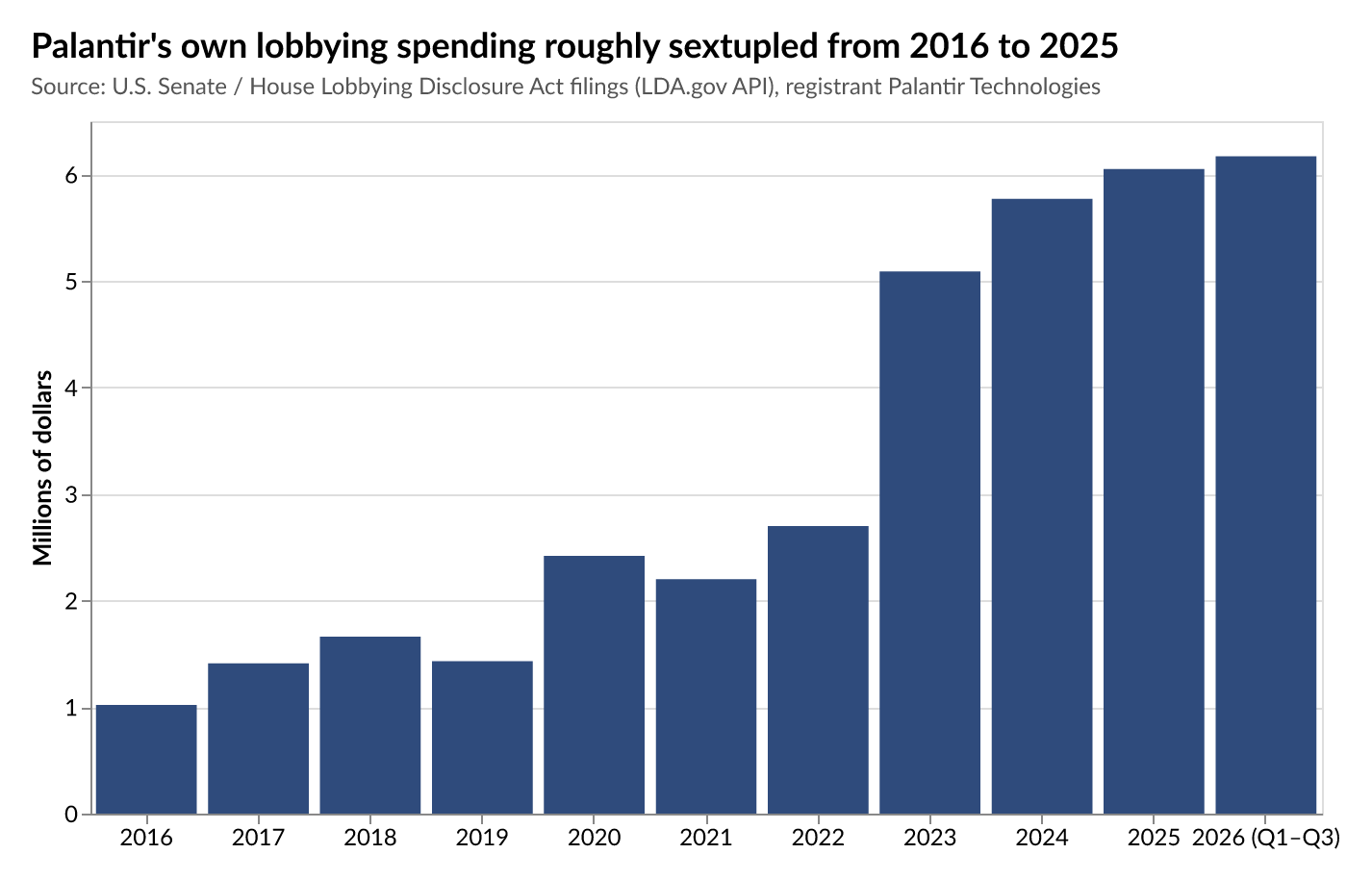
Palantir’s in-house lobbying spending, the money it reports under the Lobbying Disclosure Act, rose from $2.42 million in 2020 to $6.05 million in 2025, or from roughly $2 million to more than $6 million as NOTUS rounded it [22] (LDA filings). The company has hired more than 50 individual lobbyists, according to federal data analyzed by OpenSecrets [22]. OpenSecrets found that 25 of its 38 lobbyists in 2024 had previously held government jobs, the “revolving door” between agencies and the industries they buy from [23].
The hires track who holds power. After Trump’s 2024 win, the Tech Transparency Project reported that Palantir hired Miller Strategies, a Trump-connected lobbying firm, and, citing Punchbowl News, that it hired Machalagh Carr, who had been chief of staff to Kevin McCarthy, the former House speaker, as head of global policy [21]. In February 2026, as Democrats pressed it over its immigration work, it hired two lobbyists from Ferox Strategies with deep Democratic Party ties [22]. “We think that the narrative about Palantir in Washington is not accurate,” Ferox CEO Cristina Antelo told NOTUS [22]. Karp has also cheered on the people in charge. On the February 2025 earnings call, asked by a Bank of America analyst about the Trump administration’s DOGE cost-cutting push, Karp said the disruption would be good for Palantir and described it as a revolution in which some people would get their “heads cut off” [21][43].
Karp’s personal giving, covered in Part 1, tilts the same way. NBC News found that his largest disclosed political gifts were $1 million to MAGA Inc. and $1 million to Trump’s inaugural committee, and that his smaller checks have gone to both parties but largely to Republicans [47] (FEC, Dec. 12, 2024). OpenSecrets counts $4,943,324 in 2024-cycle contributions from Palantir’s PAC and from individuals who list Palantir as their employer, plus their immediate families [23].
“War is a racket”: a Marine general’s accounting
More than 90 years before Palantir’s proxy statement, a retired Marine general tried to do this same kind of accounting. Smedley Butler fought from the Philippines and China to Mexico, Nicaragua, Haiti and France, and is one of only two Marines to receive the Medal of Honor twice for separate actions [27][28][30]. After he retired in 1931, he turned against the interventions he had led, and in 1935 published War Is a Racket [27][28]. It opens: “War is a racket. It always has been. It is possibly the oldest, easily the most profitable, surely the most vicious. It is the only one international in scope. It is the only one in which the profits are reckoned in dollars and the losses in lives” [26].
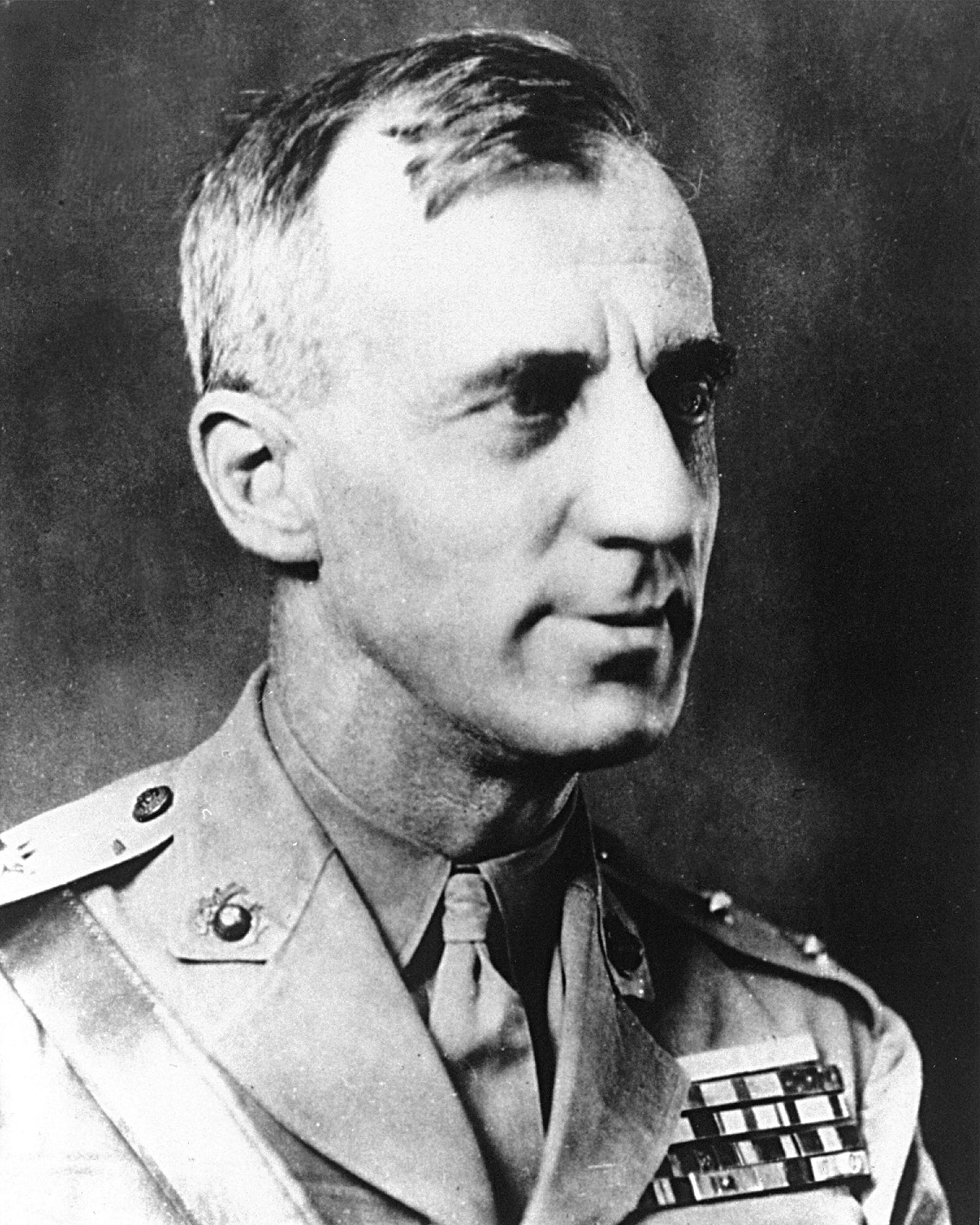
Then he did the math for World War I. Du Pont, he wrote, averaged $6 million a year in earnings from 1910 to 1914 and $58 million a year from 1914 to 1918; Bethlehem Steel went from $6 million to $49 million [26]. The profits, he wrote, were “dressed into speeches about patriotism, love of country” [26]. His fix was blunt: before drafting young men, “conscript capital and industry and labor,” and pay every executive, banker and politician the soldier’s $30 a month [26].
Butler’s own record complicates the hero version. He called the Haitians whose country he helped occupy “savage monkeys,” and at Haiti’s Fort Rivière his Marines took no prisoners [27]. In Haiti he was remembered as “The Devil” [29]. His critique came from a man who had done the racket’s enforcing himself.
One line in his book reads differently now. Describing Europe’s alliances in 1935, Butler wrote: “Again they are choosing sides” [26]. Eighty-five years later, Palantir’s prospectus declared: “We have chosen sides” [9] (S-1).
The scorecard
The running scorecard now covers five claims, including the two this part tests; the grades are explained in Part 1. I emailed Palantir questions about the claims in this series on Nov. 18, 2026, and asked for a response by Nov. 20. I followed up on Nov. 23 and asked for a response by 1 p.m. Eastern on Nov. 24. As of Nov. 23, Palantir had not responded. I’ll add its answer here if it replies, and update the grades if its answer or new records change the picture.
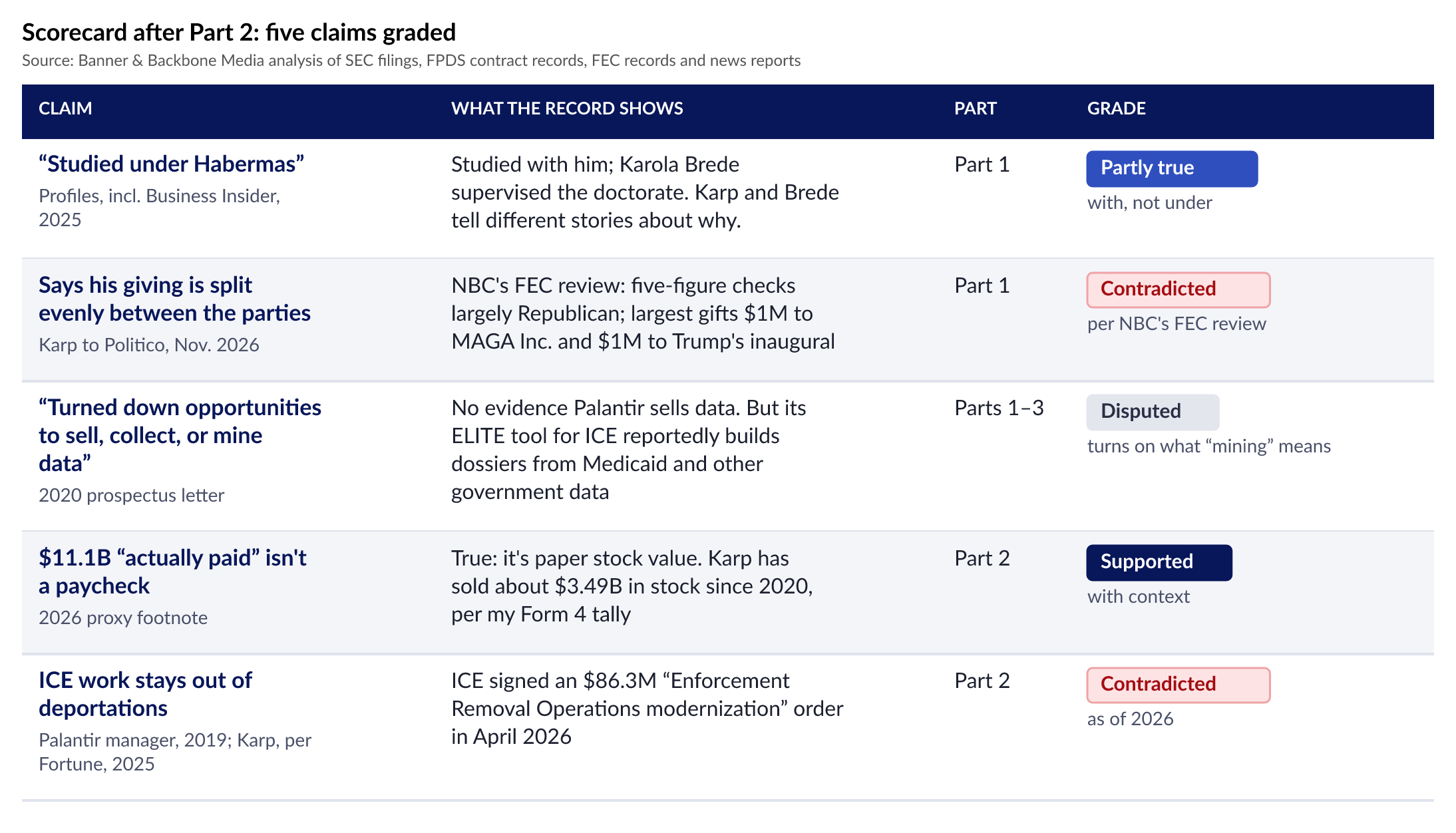
Scorecard sources:
Studied under Habermas (Partly true): Part 1
Giving split evenly between the parties (Contradicted): [47]
Turned down selling or mining data (Disputed): [14] (SEC S-1; EFF). No evidence Palantir sells data; whether running analytics on a customer’s data counts as “mining” it is a matter of definition.
$11.1 billion “actually paid” isn’t a paycheck (Supported): [1] (2026 proxy statement)
ICE work stays out of deportations (Contradicted): [7][17][34]
Our Read
The gap between those two pay numbers shows where the money goes. Karp’s $1.1 billion grant in 2020 was a bet that Palantir’s stock would rise. It rose as Palantir’s government contracts grew and, more recently, as corporations bought its AI software. The government steps ran through public money or public power: an intelligence-funded start, a lawsuit that forced the Army to take commercial software seriously, and contracts that expanded as enforcement priorities changed. When Karp sells stock, he is cashing out value built in large part on taxpayer-funded demand.
The deportation work is where Palantir’s story and the record split most clearly. For years the company drew a line between the ICE branch that investigates and the branch that deports, and as recently as 2025 Fortune reported that Karp had said Palantir didn’t work with the deportation branch. In 2026, ICE bought “Enforcement Removal Operations modernization” from Palantir. Maybe the line was accurate when it was drawn. Either way, it no longer describes Palantir’s work.
The lobbying follows the same logic: Trump allies when Trump wins, Democratic lobbyists when Democrats gain leverage, and Karp’s own checks to both parties, capped by $1 million to MAGA Inc. and another $1 million to Trump’s inaugural committee [47]. That’s normal for a federal contractor. It’s odd for one whose CEO calls the work a moral mission.
Butler’s frame fits Palantir in some ways and not in others, and the difference matters. It holds on the pattern: public spending on security turning into private fortunes, profit wrapped in patriotic language, and insiders lobbying for the budgets they sell into. Karp’s “we’re making so much money” line, even framed as money that lets Palantir do more for troops, is the kind of sentence Butler spent his last decade quoting back at contractors. It breaks on the mechanics. Butler was documenting wartime markups and waste, like wooden ships that sank and airplane engines that never reached the front [26]. I found no evidence of Palantir overcharging, and Karp’s wealth comes mostly from stock that rose on commercial as well as government growth, not from padded invoices. Narrowed to what the record shows, the comparison is this: Butler wanted the profit taken out of war, and today’s pay system ties a defense CEO’s fortune to a stock price that rises when the security state buys more.
Palantir’s defenders have real points. It builds things that customers keep buying, and its U.S. commercial business outsold its U.S. government work for the first time in the third quarter of 2026. The DCGS lawsuit pushed the Army toward commercial software after a custom program that had cost more than $6 billion. Founders who take huge risks often get huge rewards, and Karp’s last big grant dates to 2020. Even so, the founders kept voting control through Class F, the CEO has pulled out billions, and the company’s influence spending keeps climbing. Those facts make it harder to accept that the mission comes first and the money second.
Open questions
How much has Palantir been paid in total under the ICE enforcement and removal order, and what does “operational capability” for the deportation case-management system actually include?
Did Karp himself ever say Palantir doesn’t work with ICE’s deportation branch, and if so, when? Fortune says he did; the earliest public version I could find came from a Palantir product manager in 2019.
What did the original In-Q-Tel investment and pilot projects cover, and on what terms?
Will Karp adopt a new 10b5-1 selling plan when his current one runs out in November 2026?
How will Palantir’s lobbying change once Democrats control both chambers of Congress in January?
What you can do
Read the records yourself. The pay-versus-performance table in Palantir’s 2026 proxy statement shows both pay numbers side by side, and ICE’s Enforcement and Removal Operations order is public in the federal contract database. Ask your members of Congress whether they’ll press ICE and Palantir on what that order covers.
Next, in Part 3: what Palantir’s software actually does in Ukraine, Israel, ICE field operations, German policing and Britain’s National Health Service, and how Karp’s 2025 book, The Technological Republic, turns those deals into a political program.
Sources
stratrix.com — Highest-Paid CEOs: The 2026 List, From Proxy Filings | Stratrix
fortune.com — Surging stock made Palantir’s Alex Karp $6.8 billion richer last year—and one of the best-paid CEOs. By Irina Ivanova, published May 5, 2025, updated May 7, 2025 (Subscription)
sherwood.news — Palantir’s Alex Karp made $6.8 billion last year. By Matt Phillips, published Apr 25, 2025
coloradosun.com — Did the CEO of a Colorado-based corporation earn nearly $7B in 2024?. By Tyler Hickman, published Sep 5, 2025
cnbc.com — Palantir CEO Alex Karp earned cash and stock worth $1.1 billion last year. By Ari Levy, published Apr 29, 2021, updated Apr 30, 2021
fortune.com — Palantir CEO Alex Karp made nearly $2 billion from selling company stock last year—mostly in the leadup to the presidential election. By Irina Ivanova, published Feb 22, 2025
fortune.com — High-flier: Palantir CEO Alex Karp spent $17.2 million on private jets in 2025, filing reveals. By Nick Lichtenberg, published Feb 18, 2026 (Subscription)
inquirer.com — Palantir waves the flag and embraces its U.S. government roots. By Lizette Chapman, published Aug 27, 2020 (Subscription)
globalventuring.com — Case study: Farsighted Palantir sees data’s potential. published Mar 21, 2014 (Opinion)
techcrunch.com — Palantir targeting 3 class voting structure according to leaked S-1, giving founders 49.999999% control in perpetuity. By Danny Crichton, published Aug 21, 2020
arnoldporter.com — Palantir: Federal Circuit Confirms Agencies
foxbusiness.com — Palantir CEO rips Silicon Valley’s values as the Peter Thiel backed company prepares IPO. By Thomas Barrabi, published Aug 26, 2020
thenextweb.com — Palantir’s US commercial sales top government revenue for the first time. By Cristian Dina, published Nov 2, 2026
Federal Procurement Data System (GSA) — Federal contract 70CTD022FR0000170: PALANTIR TECHNOLOGIES INCORPORATED, U.S. IMMIGRATION AND CUSTOMS ENFORCEMENT. By U.S. IMMIGRATION AND CUSTOMS ENFORCEMENT, published Sep 20, 2022, updated Sep 16, 2026
Federal Procurement Data System (GSA) — Federal contract 70CTD026FC0000012: PALANTIR TECHNOLOGIES INC., U.S. IMMIGRATION AND CUSTOMS ENFORCEMENT. By U.S. IMMIGRATION AND CUSTOMS ENFORCEMENT, published Apr 30, 2026, updated Aug 19, 2026
Federal Procurement Data System (GSA) — Federal contract W9128Z26FA001: PALANTIR USG INC, DEPT OF THE ARMY. By DEPT OF THE ARMY, published Nov 21, 2025, updated Aug 18, 2026
defensescoop.com — ‘Growing demand’ sparks DOD to raise Palantir’s Maven contract to more than $1B. By Brandi Vincent, published May 23, 2025
washingtontechnology.com — Palantir signs $10B enterprise agreement with Army. By Nick Wakeman, published Aug 1, 2025
techtransparencyproject.org — TTP - Inside Palantir’s Expanding Influence Operation
washingtonsun.com — Palantir Hires Two New Lobbyists With Democratic Party Ties. By Samuel Larreal, published Mar 18, 2026, updated Mar 19, 2026
opensecrets.org — Palantir Technologies Profile: Summary
Wired — Alex Karp Said He’s a ‘Progressive.’ OK! Here’s Some Other Stuff He’s Said Recently. By Caroline Haskins, published Nov 12, 2026
jameslandrith.com — War Is A Racket. published Dec 31, 2002, updated Sep 1, 2026
americanheritage.com — Ollie And Old Gimlet Eye
ebsco.com — Smedley Butler | History | Research Starters | EBSCOhost
historynewsnetwork.org — Why Smedley Butler Turned Against US Empire. By Patrick Iber, published Jan 11, 2022
historynet.com — Gangsters of Capitalism Review: Was Smedley Butler the Embodiment of American Imperialism?. By Claire Barrett, published Jan 21, 2022, updated Sep 27, 2022 (Subscription)
fortune.com — Controversial Startup Palantir Denies Assisting ICE With Family Separations. By Aaron Pressman, published Dec 11, 2019, updated Dec 12, 2019 (Subscription)
roic.ai — Palantir Technologies Inc. (PLTR) Q4 FY2024 Earnings Call Transcript. By Roic AI, published Feb 3, 2025
nbcnews.com — New megadonors with major business before the government back Trump’s super PAC. By Ben Kamisar, published Jan 12, 2026
Chart data
“Compensation actually paid” is an SEC-required measure that marks a CEO’s unvested and newly vested equity to market each year; it rises and falls with the stock price and is not cash received. Millions of U.S. dollars. — data: SEC EDGAR: Palantir Technologies 2026 proxy statement (DEF 14A), pay-versus-performance table (Public domain)
Revenue and GAAP net income attributable to common stockholders, by calendar year, in millions of U.S. dollars. 2018–2020 net income from XBRL filings; 2021–2025 net income from Palantir’s 2026 proxy pay-versus-performance table. — data: SEC EDGAR: Palantir Technologies (CIK 1321655) 10-K XBRL financial data and 2026 DEF 14A (Public domain)
Gross proceeds (shares × reported weighted-average price) from every sale of Class A stock Karp reported on SEC Form 4, Sept. 30, 2020 – Aug. 20, 2026, in millions of U.S. dollars. “Tax sell-to-cover” marks sales the filings themselves describe as automatic sales to cover tax withholding when restricted stock vested. 2026 is partial. Banner & Backbone tally of 58 filings, 50 of which report sales. — data: SEC EDGAR: Form 4 filings by Alexander C. Karp (reporting owner CIK 1823951), compiled by Banner & Backbone Media (Public domain)
Expenses reported by Palantir Technologies as a self-filing registrant under the Lobbying Disclosure Act, in millions of U.S. dollars. Excludes fees paid to outside lobbying firms. 2026 covers Q1–Q3 only. Banner & Backbone tally of LDA quarterly reports, pulled Nov. 16, 2026. — data: U.S. Senate / House Lobbying Disclosure Act filings (LDA.gov API), registrant Palantir Technologies (Public domain)
The Karp Files running scorecard after Part 2. Grades as of Nov. 18, 2026; grades are explained in Part 1, and Part 3 adds the claims it tests. Sources for every row are listed below the image. — data: Banner & Backbone Media analysis of SEC filings, FPDS contract records, FEC records and news reports
Compiled from 30 sources across 25 outlets. Source text as of Nov 23, 2026.
Banner & Backbone Authors’ Notes
Check out the new BroadBanner calendar and creator tools!

You being here shows that you have already begun the process of unfurling new Banners and forging new Backbones for a more progressive America. Please, take the time to become a paid, or free, subscriber to the Network — supporting us all and ensuring everyone in America can hear these messages.
The America we strive for — it is one where we willingly remember the teachings of our past, humbly learn from our failings, proudly celebrate our successes, and boldly lead the way into a future for all people.
Actions You Can Take
Call your public servants on important issues:
Join the efforts to de-flock the States:
Service members can get un-biased information on legal vs illegal orders:
Reach out on Signal: @TheOrdersProject.76
Reach out to the team if you are interested in volunteering time, supporting, and building these community driven platforms:
Submit feedback directly to: info@bannerandbackbone.com
Support and subscribe to Banner & Backbone!

Great information, thanks