The Government Cut People First. Here’s What the Record Shows It Cost.
Part 1 of 6: I checked 12 federal lapses since January 2025 against the official record. Two trace to lost capacity, and the people-first approach ran roughly against Project 2025’s own warning.


On July 6, 2025, two days after floodwater tore through the Texas Hill Country, many people calling the Federal Emergency Management Agency couldn’t get through. From July 6 to July 10, “unanswered calls reached as high as 84 percent” on FEMA’s helpline, and average waits peaked at about an hour, the Government Accountability Office found [1] (p. 10). FEMA officials told GAO why: earlier that year, the agency “had reduced its surge support resources by about 50 percent” [1] (p. 10). They said they made that cut after call volume began to normalize in early 2025, so the agency could focus on earlier disaster declarations [1] (p. 10).
That is the cleanest line I could find, in almost two years of federal records, running from a cut to a failure. GAO wrote it down, and FEMA’s own officials explained it [1] (p. 10). It was FEMA’s own call, not one ordered from above, and that distinction runs through this series.
The Brief Briefs
Of 12 federal lapses since January 2025, two have an official record tying them to lost capacity: IRS paper returns [13] (p. 2) and FEMA’s flood helpline [1] (p. 10).
The largest single program route out of government in 2025 was a paid-leave resignation offer, about a third of departures [2] (p. 8). Project 2025’s own personnel chapter warned that “simply reducing numbers can actually increase costs” [5] (p. 10).
The deadliest event, the DCA midair collision, is not a cuts story. The NTSB’s probable cause centered on where the FAA placed a helicopter route [19] (p. 26).
This series asks a narrow question and tries to answer it with documents instead of vibes. Which federal institutions failed after the inauguration? What changed at each one beforehand? Did Project 2025’s Mandate for Leadership call for that change? And how strong is the evidence that the change caused the failure?
I checked 14 events, collapsed into 12 lapses, against inspector general reports, GAO audits, the National Transportation Safety Board, court rulings and the agencies’ own statements. The short version: two have an official record tying them to lost service capacity. The way the government shrank, people first rather than function by function, is roughly what the Mandate‘s own personnel chapter warned against. Parts 2 through 6 take each cluster in turn.
What “the cuts” means here
By “the cuts” I mean the 2025 reductions in federal staff and service capacity, by any route: the executive orders, the resignation offers, layoffs, and agencies’ own resourcing decisions. Where a cut was an agency’s own call rather than one ordered from above, I say so.
Two things happening in sequence is not proof that one caused the other. So every event is graded on a specific claim, not on the agency as a whole, and the grades are defined just above the scorecard. A grade is what lets you defend a claim when someone pushes back, and on this subject someone always pushes back.
The disavowal, and who ran the budget anyway
The Mandate for Leadership is the policy book behind Project 2025, the Heritage Foundation’s playbook for the next conservative administration [9]. On July 5, 2024, Donald Trump posted, “I know nothing about Project 2025,” and “I have no idea who is behind it” [9]. He added that some of its proposals were “absolutely ridiculous and abysmal” [9]. Project 2025 said at the time that it “does not speak for any candidate or campaign,” and that it was up to the next president to “decide which recommendations to implement” [9].
On Feb. 6, 2025, the Senate confirmed Russell Vought as director of the Office of Management and Budget on a 53-47 party-line vote [10]. The Associated Press described Vought as “one of the architects of Project 2025” [10]. He wrote the Mandate‘s chapter on the Executive Office of the President [8] (p. 1). He had also run OMB in Trump’s first term [10].
What that shows is overlap in people, not proof that the book was followed. The fair test is to put what the Mandate says next to what the government did, agency by agency. That’s the rest of this series.
What the blueprint said
This part sets the Mandate‘s text beside the record for the workforce as a whole, the IRS and NOAA. Parts 2 through 5 take up the chapters on the other agencies. On NOAA, the book is direct. The Commerce chapter, written by Thomas F. Gilman, calls the National Oceanic and Atmospheric Administration “one of the main drivers of the climate change alarm industry” and says “It should be broken up and downsized” [6] (p. 13). It says the National Weather Service “should focus on its data-gathering services” and “fully commercialize its forecasting operations” [6] (p. 13).
On the IRS, the Treasury chapter does not call for gutting the agency. “The operating budget of the IRS should be held constant in real terms,” it says [7] (p. 11). It also says more resources could follow if IT management changes and “serious oversight is put in place” [7] (p. 11). But the same chapter opposed what it called the Inflation Reduction Act’s “radical $80 billion expansion of the IRS,” which it said was enough to double the agency’s workforce [7] (p. 10).
The sharpest passage is in the personnel chapter, by Donald Devine, Dennis Dean Kirk and Paul Dans [5] (p. 1). It warns that headcount cuts can backfire.
“Simply reducing numbers can actually increase costs.” — Mandate for Leadership, Central Personnel Agencies chapter [5] (p. 10)
The chapter singles out buyouts. It says a Clinton-era buyout “cost the Treasury $2.8 billion, mostly for those who were going to retire anyway” [5] (p. 10). It argues “cutting functions, levels, funds, and grants is much more important than setting simple employment size” [5] (p. 10). And it tells a future president to “be wary of costly types of reductions-in-force” [5] (p. 11).
Hold that warning up against what came next.
What the machine actually did
The machinery ran on executive orders. On Jan. 20, 2025, Executive Order 14158 renamed the U.S. Digital Service as the U.S. DOGE Service and required every agency head to stand up a DOGE team of at least four people [4]. On Feb. 11, 2025, Executive Order 14210 told the OMB director to plan a smaller workforce in which each agency would “hire no more than one employee for every four employees that depart” [3]. It also barred agencies from filling career vacancies that their DOGE team lead said should stay empty, unless the agency head overruled it [3]. And it told agency heads to “promptly undertake preparations to initiate large-scale reductions in force” [3].
GAO’s count of the results is the most complete one I’ve found. Across the 22 largest agencies that reported data, the workforce “declined by nearly 256,000 employees—or over 11 percent” during 2025 [2] (p. 5). That was the net of about 378,000 departures and 127,000 hires [2] (p. 5). Every one of the 22 ended the year smaller, and 18 of them shrank by more than 10% [2] (p. 5).
Of the 377,722 separations GAO tallied, 128,589 (34%) were people who took the deferred resignation offer [2] (p. 8). That offer let employees stop working but stay on full pay and benefits through Sept. 30, 2025 [12] (p. 7). Only 6,331 (1.7%) were separated through reductions in force, the formal layoff process, and another 10,243 (2.7%) took early retirement tied to a reduction in force or reorganization [2] (p. 8). Another 6,697 (1.8%) were probationary employees fired during their trial periods [2] (p. 8).
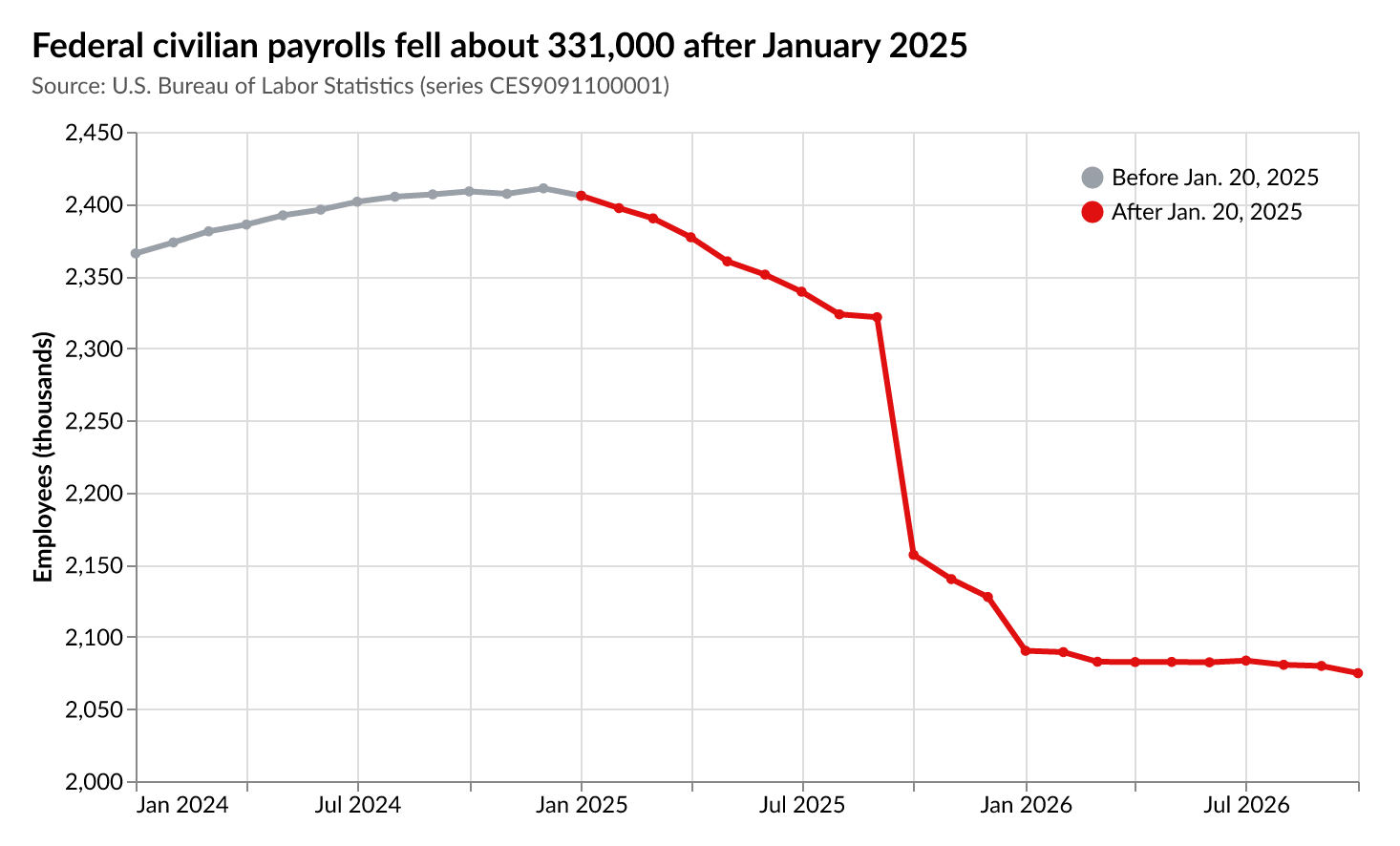
My read: the government shrank in roughly the way the Mandate‘s own personnel chapter warned against. Its largest single program route out was a paid-leave resignation offer [2] (p. 8), which resembles the buyouts the chapter warned about: people paid to leave rather than functions cut. The chapter’s authors wanted functions and grants cut first [5] (p. 10). The 2025 approach cut people first and sorted out functions afterward.
GAO estimates the paid leave tied to the resignation offer cost about $6.7 billion in 2025, and cautions that the payroll data behind its estimate could overstate leave use [11] (p. 2). It also found that, because that leave isn’t tracked separately, there is “no way to accurately determine” whether the government’s cost-savings goal is being met [11] (p. 28). So whether the offer ends up costing more than it saves, as the chapter warned buyouts can, isn’t settled.
The executive order called for large-scale layoffs [3], and Congress and the courts later slowed that route [2] (p. 5) [12] (p. 9). By GAO’s count, the resignation offer moved about 20 times as many people out of government as formal layoffs did: 128,589 against 6,331 [2] (p. 8). Counting early retirements tied to layoffs or reorganizations, it’s still nearly eight to one [2] (p. 8). Ordinary retirements and resignations still made up the biggest share [2] (p. 8).
Where practice outran the text
The IRS is the clearest case. The Mandate asked to hold its operating budget flat in real terms [7] (p. 11). By January 2026, 31,273 IRS employees had left, about 30% of the workforce, and the net drop after rehiring was 28%, according to the Treasury Inspector General for Tax Administration [12] (p. 2). Taxpayer Services alone lost 11,330 people [12] (p. 14).
The IRS also cycled through seven commissioners in 2025 [12] (p. 16). The comparison with the Mandate is approximate: its benchmark was a budget, not a headcount, and it wanted the IRA expansion reversed [7] (p. 10).
The service consequences showed up in the 2026 filing season. IRS officials told GAO the agency’s individual paper-return system could not process tax year 2025 returns for the first six weeks of 2026, and its business-return scanner was down the entire season [13] (p. 2). They said the systems weren’t ready “due to the recent loss of experienced IT acquisition staff” [13] (p. 2).
Paper individual returns took an average of 30 days; GAO doesn’t say whether those are calendar or working days. It does say the average exceeded the IRS’s own policy of processing them within 13 working days, though it was shorter than in the pandemic-backlog seasons of 2021 and 2022 [13] (p. 3). Fully staffed walk-in Taxpayer Assistance Centers fell from 102 to 42 [13] (p. 11).
FEMA is the second case. Part 3 sets the Mandate‘s Homeland Security chapter beside the record; here, the courts have already weighed in. U.S. District Judge Susan Illston ruled in September 2026 that Homeland Security officials had directed FEMA to submit a plan with a 50% staffing cut over its own supervisors’ objections [15]. “Frankly, the FEMA staffing plan number appears as if pulled from thin air,” Illston wrote [15]. The 50% cut was not carried out, and FEMA has rehired some staff [15].
FEMA said it does not comment on personnel matters or ongoing litigation, and that “DHS and FEMA are ready for the 2026 hurricane season” [15]. Separately, GAO found FEMA cut staff in 2025 without first checking whether it could still meet its statutory obligations [21].
Congress also stepped in. The Continuing Appropriations Act, 2026, generally barred federal funds from being used to start or carry out reductions in force from Nov. 12, 2025, through Jan. 30, 2026 [2] (p. 5). Both rounds of IRS layoff notices were cancelled by court orders [12] (p. 9).
What this leaves out: neither the Mandate, the executive orders nor DOGE made the specific call that broke FEMA’s phone line in July 2025. FEMA officials told GAO the agency itself cut its surge call support after call volume began to normalize, so it could work through prior disaster declarations, including a record 56 for individual assistance in 2024 [1] (p. 10). On the record, that’s an agency resourcing decision, not a mandated workforce cut, and nothing I found ties it to DOGE or the executive orders. That’s why later parts of this series name who decided what.
The scorecard
Twelve rows, newest first. I collapsed the two IRS filing seasons and the two SSA events into single rows. Each row is graded on a specific claim, not on the agency as a whole. A few rows carry two grades: one for whether the change itself is on the record, and one for whether it did harm.
Documented cause: an official record (an audit, an inspector general report or a court ruling) ties the change to the failure. That includes an agency’s own officials explaining a failure to auditors, and I say so when that’s the basis.
Contributing factor: credible evidence (sworn testimony, internal records, named officials) ties them, short of an official record. No row meets this bar yet.
Plausible, unproven: the timing and the mechanism fit, but nobody has shown the link.
No link shown: the record so far neither shows a link nor rules one out.
Pre-existing: the problem clearly predates 2025.
Contradicted: the evidence points somewhere else.
Documented change: an official record shows the change happened, separate from whether it caused harm.
How I weigh what officials say. An agency’s officials telling auditors that lost capacity caused their own failure are conceding a failure, so I count that as a documented cause. An office telling an inspector general that its staffing didn’t affect its work is defending itself, so I don’t treat that as settling the question either way.
The Project 2025 column asks whether the Mandate‘s text called for the change. Direct means it did, Mixed means it pointed both ways, and Not applicable means nothing changed. Where I haven’t yet set the relevant chapter beside the record, the cell names the part of this series that will.
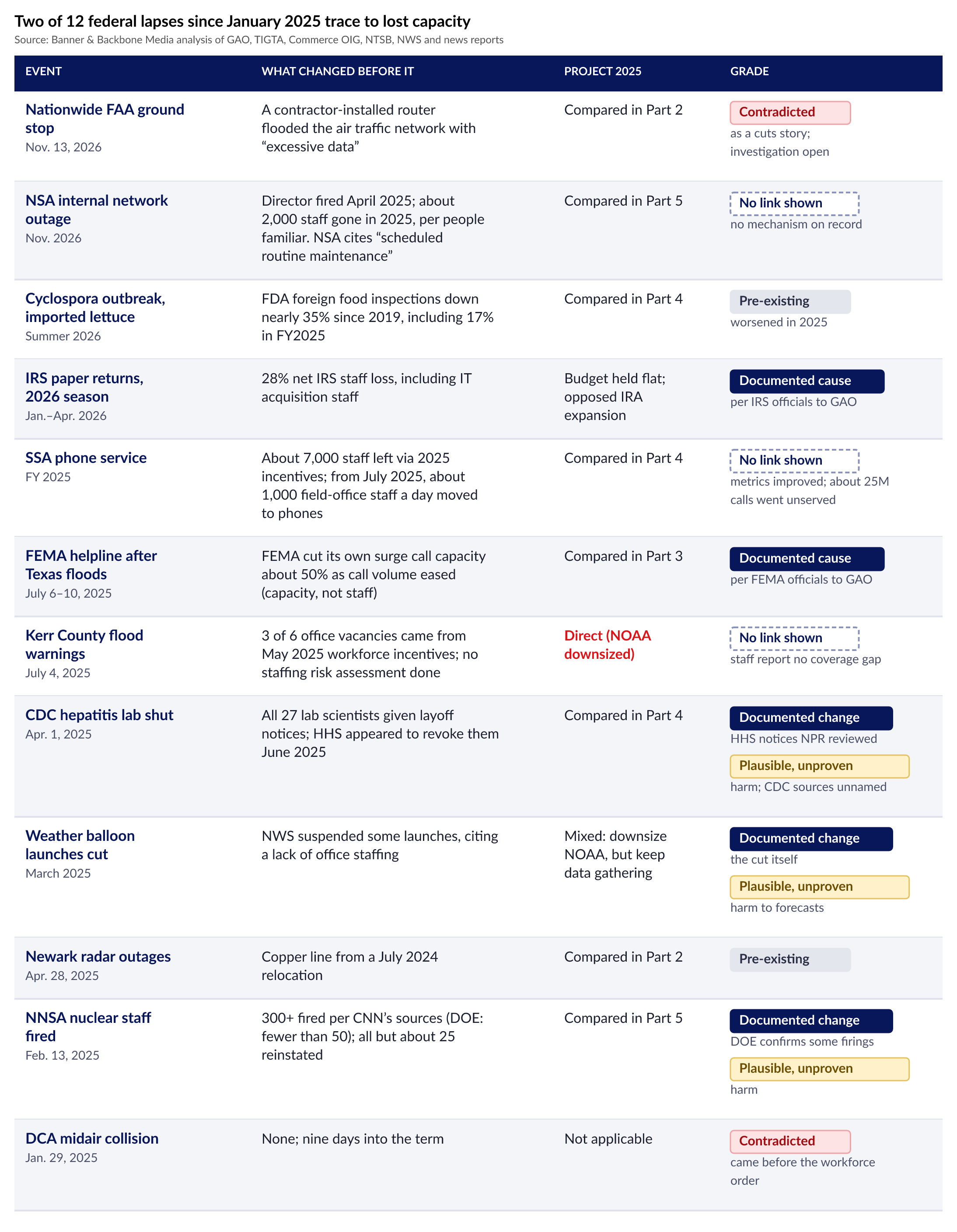
Scorecard sources, row by row: FAA ground stop [22]; NSA outage [28][30]; cyclospora outbreak [26]; IRS paper returns [7][12][13]; SSA phone service [14][25]; FEMA helpline [1][21]; Kerr County [6][18]; CDC lab [20][29]; weather balloons [6][16][17]; Newark radar [24]; NNSA firings [23]; DCA collision [19].
Two lapses earn a documented cause, and both run through capacity. At the IRS, officials blamed the loss of experienced IT acquisition staff [13] (p. 2). At FEMA, it was the agency’s own resourcing call, as above [1] (p. 10). In both, the link comes from the agency’s own officials, as GAO recorded it.
The weather service’s balloon launches are a documented change. The Weather Service’s own notice suspended some launches “due to a lack of Weather Forecast Office (WFO) staffing” [17] (p. 1). Nobody has measured the harm [16].
The CDC’s hepatitis lab is a documented change with unproven harm. HHS sent layoff notices to all 27 of the lab’s scientists in April 2025 [20]. In June, NPR obtained HHS emails revoking the layoff notices of more than 400 CDC workers, which it reported may reinstate the lab’s entire staff [29]. CDC staff told NPR the lapse damaged equipment at the center’s labs, with at least one machine needing repairs, and that some outbreaks were not properly tracked [29]. Those staff asked not to be identified, which keeps the harm at plausible but unproven [29].
The nuclear weapons agency’s firings are a documented change because the Energy Department itself confirmed them, while disputing their scale: it said “less than 50 people” were dismissed, mostly from administrative and clerical roles, against the 300-plus CNN’s sources described [23].
The deadliest event, the Jan. 29, 2025, midair collision over the Potomac [19], came nine days after the inauguration. The NTSB’s probable cause centered on the FAA’s “placement of a helicopter route in close proximity to a runway approach path” [19] (p. 26).
The NTSB also listed the workload of combined tower positions as an additional causal factor [19] (p. 26). The tower had its authorized 28 certified controllers on the roll, 25 of them operational [19] (pp. 89–90). The supervisor on duty told investigators that combining the positions was “standard” and that enough people were on duty to split them [19] (p. 100), though the tower’s own procedures said the helicopter position should normally be split at that hour [19] (pp. 100–101). The NTSB’s staffing figures and the tower’s own procedures, not just the supervisor’s account, point to the route and a discretionary local call rather than a cut, so I grade the collision contradicted as a cuts story.
Kerr County is harder to grade. Weather office officials told the Commerce Department’s inspector general the office “did not experience a gap in shift coverage” [18] (p. 18), and staff said the vacancies didn’t affect their warnings [18] (p. 3).
But the inspector general also reported that no risk assessment had been done on the office’s vacancies [18] (p. 21). Three of its six vacancies came from May 2025 workforce incentives, including the warning coordination meteorologist, the office’s main link to county officials [18] (pp. 19, 21). That’s the office’s account of itself, not an independent finding (see the grading note above), so I grade it no link shown rather than contradicted. The inspector general’s separate review of Weather Service staffing was still under way when the report came out [18] (p. 7).
Social Security’s phones also get no link shown. The inspector general’s audit found that about 25 million calls in fiscal 2025 ended without the caller being served, counting hang-ups and unanswered callbacks [14]. From July 2025, roughly 1,000 field office employees a day were moved onto the national phone line, and the audit did not evaluate what that did to service at local offices [14].
The strongest case for the cuts
The administration’s case starts with money. OPM Director Scott Kupor called the resignation offer a one-time cost that buys lasting savings: “the government will save $20+ billion in costs, annually,” he wrote [27]. GAO’s report records the same expectation from OPM’s leadership [11] (p. 26), though its auditors also said the government’s leave data can’t yet show whether that goal is being met, as noted above [11] (p. 28). EO 14210 framed the cuts as “eliminating waste, bloat, and insularity” [3].
Most taxpayers had a normal 2026 filing season: the IRS processed about 98% of 177 million returns, and 95% were e-filed [13] (p. 2). GAO found the 2025 season processed the same share [13] (p. 2).
The agencies have their own answers. Social Security’s inspector general found the agency’s published phone metrics accurate and its phone service improved in fiscal 2025, and Commissioner Frank Bisignano said the agency is “serving more Americans at significantly faster speeds than ever before” [25].
There’s also a fair point about baselines. FEMA’s staffing problems, the FAA’s aging equipment and the FDA’s falling inspection numbers all predate 2025, and the records say so [21][22][26]. An honest series can’t blame 2025 for problems that were already there. The FDA trend did get worse on this watch, though: foreign food inspections fell another 17% in fiscal 2025, to 1,140 [26].
My read: the agencies’ defenses and the baseline point both hold, and neither changes the documented cases. A smaller government is a legitimate policy choice. Cutting the capacity people rely on when they need the government most is a different thing, and the IRS and FEMA records show what that costs.
What we can’t say yet
We can’t say the cuts caused the Nov. 13 ground stop. The FAA has tied it to a newly installed router, and the root cause is still under investigation [22]. Hewlett Packard Enterprise, which owns the router maker, Juniper, told ABC News the device “functioned as it was configured to by the installer,” according to the Associated Press [22].
We can’t tie the NSA’s November outage to its 2025 staffing and leadership changes either. The agency shed about 2,000 people in 2025, according to three people familiar with it who spoke to Nextgov, and its director was fired that April [30]. But the only official account of the outage is the agency’s, which blames “scheduled routine maintenance” [28].
And we can’t say the canceled weather balloon launches made forecasts worse; scientists warned they would add uncertainty, but I found no study measuring it [16].
Open investigations could move these grades, including the FAA’s root-cause review of the ground stop [22]. I’ll update the scorecard when they land, and Part 2 takes up the Commerce inspector general’s separate review of Weather Service staffing, which was still open as of its April report [18] (p. 7).
Read the series
The government cut people first. Here’s what the record shows it cost. (this piece)
Planes and floods: the disasters the cuts didn’t cause, and the margins they did thin (FAA, NWS)
The phones went unanswered: what GAO found about FEMA after the Texas floods
The slow failures: IRS, CDC and SSA
What we can’t see: the security agencies and the limits of the record (NSA, NNSA, CISA)
Who decided? The pattern, the myths, and what to watch
What you can do now: read the source documents yourself. Every report in this piece is linked in the Sources below. If you call your representative, ask one specific question. Will the new Congress require agencies to show a workforce analysis before the next round of cuts, as GAO has urged for FEMA [15][21]?
Sources
gao.gov — GAO-26-108154, Disaster Assistance High-Risk Series: FEMA Assistance for Disaster Survivors. By U.S. Government Accountability Office,
http://www.gao.gov
, published Apr 17, 2026, updated Apr 20, 2026
gao.gov — GAO-26-108583, Federal Agency Workforce Changes: Update for July 2025 to January 2026. By U.S. Government Accountability Office,
http://www.gao.gov
, published Jun 12, 2026, updated Jun 15, 2026
Federal Register — Implementing the President’s “Department of Government Efficiency” Workforce Optimization Initiative. By Executive Office of the President, published Feb 14, 2025
Federal Register — Establishing and Implementing the President’s “Department of Government Efficiency”. By Executive Office of the President, published Jan 29, 2025
web.archive.org — Mandate for Leadership Ch. 3 Central Personnel Agencies. published Apr 14, 2023
web.archive.org — Mandate for Leadership Ch. 21 Department of Commerce (Gilman). published Apr 14, 2023
web.archive.org — Mandate for Leadership Ch. 22 Department of the Treasury. published Apr 14, 2023
web.archive.org — Mandate for Leadership Ch. 2 Executive Office of the President (Vought). published Apr 14, 2023
krdo.com — Trump seeks to distance himself from pro-Trump Project 2025. By CNN Newssource, published Jul 5, 2024
pbs.org — WATCH: Senate confirms Project 2025 architect Russell Vought to lead powerful White House OMB. published Feb 6, 2025
gao.gov — GAO-26-108477, FEDERAL WORKFORCE: Deferred Resignation Program Largely Responsible for Sixfold Increase in Paid Administrative Leave Salary Costs. By U.S. Government Accountability Office,
http://www.gao.gov
, published Sep 10, 2026, updated Sep 11, 2026
tigta.gov — Snapshot Report: Status of the IRS’s Workforce as of January 2026. By TIGTA, published Jun 9, 2026, updated Jun 10, 2026
gao.gov — GAO-26-109074, 2026 Filing Season: Preliminary Observations on IRS Performance. By U.S. Government Accountability Office,
http://www.gao.gov
, published Jul 20, 2026, updated Aug 7, 2026
moneytalksnews.com — Social Security Reports Short 7-Minute Phone Waits, but That’s Not the Whole Truth. published Oct 9, 2026
pbs.org — Federal judge rules Homeland Security plan for 50% FEMA staffing cuts was unlawful. published Sep 13, 2026
insideclimatenews.org — NOAA Cuts Weather Balloon Launches Due to Staff Shortages After DOGE Layoffs. By Vernon Loeb, Dennis Pillion, published Mar 25, 2025, updated Mar 26, 2025
weather.gov — NWS PNS 25-11 suspension of upper-air launches Albany and Gray. By Carlos Diaz (DWH), published Mar 7, 2025
oversight.gov — Commerce OIG-26-017-I Review of NWS Actions to Support Kerr County. By Office of Inspector General, U.S. Department of Commerce, published Apr 8, 2026, updated Apr 9, 2026
ntsb.gov — Midair Collison Over the Potomac River, Washington, DC, January 29, 2025. By NTSB, published Feb 25, 2026, updated Feb 26, 2026
kpbs.org — In the middle of a hepatitis outbreak, U.S. shutters the one CDC lab that could help. By Chiara Eisner, published Apr 16, 2025
gao.gov — GAO-26-108427, FEMA WORKFORCE: Staff Reductions and Lack of Planning May Impact Mission Readiness. By U.S. Government Accountability Office,
http://www.gao.gov
, published Jul 30, 2026, updated Jul 31, 2026
PBS NewsHour — FAA stops installation of routers it linked to national ground stop. By Josh Funk, Associated Press, Kevin Freking, Associated Press, published Nov 17, 2026
ktvz.com — Trump officials struggled to reinstate nuclear weapons staff after firing hundreds. By CNN Newsource, published Feb 17, 2025
keyt.com — Inside the multi-day meltdown at Newark airport. By CNN Newsource, published May 6, 2025
nextgov.com — SSA phone wait times longer than publicly reported metrics, per OIG report. By Natalie Alms, published Dec 22, 2025
pbs.org — Cyclospora outbreak followed years of declining FDA foreign inspections. published Sep 9, 2026
opm.gov — What They Got Wrong About the Deferred Resignation Program (OPM, Kupor)
Al Jazeera — NSA attributes US network outage to routine ‘maintenance’ activities. By Al Jazeera Staff, published Nov 17, 2026
kpbs.org — More than 400 CDC staff may be called back to work after being laid off in April. By Chiara Eisner, published Jun 12, 2025
nextgov.com — NSA has met 2,000-person workforce reduction goal, people familiar say. By David DiMolfetta, published Dec 2, 2025 Publisher’s note: Editor’s note: This article has been updated to correct the rate of planned DOD budget cuts and add details about NSA staffing numbers.
Chart data
All employees, federal government excluding the U.S. Postal Service, seasonally adjusted, thousands. The October 2025 drop is when deferred-resignation employees, paid through Sept. 30, left the payroll count. September and October 2026 are preliminary. The vertical axis starts at 2,000. — data: U.S. Bureau of Labor Statistics (series CES9091100001) (Public domain)
The scorecard: 12 federal lapses since January 2025, each graded on the claim that the cuts caused or contributed to it. Grades as of Nov. 18, 2026. Sources for every row are listed below the image. — data: Banner & Backbone Media analysis of GAO, TIGTA, Commerce OIG, NTSB, NWS and news reports
Compiled from 30 sources across 17 outlets. Source text as of Nov 23, 2026.
Banner & Backbone Authors’ Notes
Check out the new BroadBanner calendar and creator tools!

You being here shows that you have already begun the process of unfurling new Banners and forging new Backbones for a more progressive America. Please, take the time to become a paid, or free, subscriber to the Network — supporting us all and ensuring everyone in America can hear these messages.
The America we strive for — it is one where we willingly remember the teachings of our past, humbly learn from our failings, proudly celebrate our successes, and boldly lead the way into a future for all people.
Actions You Can Take
Call your public servants on important issues:
Join the efforts to de-flock the States:
Service members can get un-biased information on legal vs illegal orders:
Reach out on Signal: @TheOrdersProject.76
Reach out to the team if you are interested in volunteering time, supporting, and building these community driven platforms:
Submit feedback directly to: info@bannerandbackbone.com
Support and subscribe to Banner & Backbone!

Discussion about this post