The 'Philosopher' Who Chose Sides
The Karp Files, Part 1: the legend calls him Habermas’s protégé. The record shows a student who says Habermas declined to keep supervising him, a dissertation on aggression, and shifting labels.


The Brief Briefs
Alex Karp studied with Jürgen Habermas in Frankfurt but finished his doctorate under the sociologist Karola Brede, and her account of why doesn’t match his [6][7].
His dissertation is about how aggression holds groups together and how a speaker wins a crowd through form, not argument [6][7].
His political labels keep shifting, while his largest disclosed political gifts, $1 million each, went to MAGA Inc. and Donald Trump’s inaugural committee [32].

In a Playbook interview Politico published on Nov. 11, 2026, a week after the midterm elections that will give Democrats majorities in both chambers of Congress, Palantir CEO Alex Karp made his pitch to the party (Politico Playbook). “I’ve been a Democrat my whole life. I grew up in a far left environment. I know more about being a progressive than almost anybody on the planet, and I absolutely believe Palantir — all of our products are essentially progressive,” he said [1]. Politico noted that Karp had once called the Democratic Party “totally irresponsible”; Wired dates that remark to October 2025 [1]. Less than two years earlier, he had given $1 million to MAGA Inc., the pro-Trump super PAC [32].
That is the man this series is about. Wired describes Palantir as the company that built the technology underpinning much of the Trump administration’s arrest and deportation campaign, that sold the U.S. military tools able to use generative AI to help plan drone strikes, and that partnered with Israel’s military [1]. Its CEO keeps changing how he describes his own politics. Defense reporter Sharon Weinberger, whose new book tracks the rise of Silicon Valley’s defense firms, called Karp “always a bit of a chameleon” and “a master of narrative” [2].
I don’t think the labels are the story. I think there is a long-running theme in how Karp thinks: that groups are held together by shared aggression, and that a speaker wins a crowd through form, not argument. It runs back to a German sociology dissertation that most people who write about him have never read. This is Part 1 of 3: where Karp came from, what he actually studied, how Palantir started, and what he says he believes, in his own words, before I tell you what I make of it.
A protest kid from Philadelphia
Karp grew up in Philadelphia [3]. He has described being raised by left-wing, activist parents; Business Insider reports he has said they took him to labor rights demonstrations and anti-Reagan protests as a child, and Fortune, summarizing a 2024 New York Times interview, described him as having grown up in a leftist family [3][4].
He earned his bachelor’s degree at Haverford College, then went to Stanford Law School, where Peter Thiel was a classmate [3][6][8].
Weinberger says her book includes Karp’s Haverford yearbook photo, in which he is “draped in a keffiyeh,” the Palestinian scarf [2]. She calls his politics since then a “triple pivot” [2].
Frankfurt: Habermas’s student, Brede’s doctoral candidate
After law school, Karp moved to Germany for a doctorate at Goethe University in Frankfurt [3][7]. This is where the most repeated claim about him comes from. Business Insider’s 2025 profile, like many earlier ones, says he went there “studying under famed philosopher Jürgen Habermas” [3][7]. Habermas, who died on March 14, 2026, at 96, was the best-known heir of the Frankfurt School of social theory [21].
The record supports half of that sentence. Karp did study with Habermas. What he did not do is finish his doctorate under him.
Media scholar Moira Weigel, who read the dissertation, wrote in 2020 that “tech industry legend has it that Karp wrote his dissertation under Jürgen Habermas,” but that Karp earned his doctorate in the Division of Social Sciences rather than at the Institute for Social Research [7]. His primary reader, she found, was the social psychologist Karola Brede, who held a joint appointment in sociology and at the Sigmund Freud Institute [7].
In an interview Le Grand Continent published on March 18, 2026, Brede gave her own account [6]. She said it was Habermas who phoned her and asked if she would talk with the young American [6]. Karp attended Habermas’s seminars and office hours and took ideas from him, she said, but as far as she could tell the two apparently did not reach agreement on important points [6]. Karp then asked Brede to supervise the dissertation, and settled the change with Habermas, which she described as “undramatisch,” or undramatic [6].
Brede remembered him as a young scholar trying to find his footing in German academia, saying of their first meeting, “Da war nichts Exaltiertes, Nonkonformistisches”: there was nothing eccentric or nonconformist about him [6]. She offered him a tutoring job on the spot and suggested he join a working group at the Freud Institute, which he did [6].
Karp tells it differently. In a Politico essay published March 20, 2026, six days after Habermas died, he wrote that he arrived in Frankfurt in the summer of 1992 and met Habermas “dozens” of times in the 1990s to discuss his research (Politico essay). Politico’s note on the essay discloses that Karp sat on the supervisory board of Axel Springer, Politico’s parent company, from April 2018 to early 2020.
On Aug. 10, 2000, he wrote, he received a three-page typed letter from Habermas, “forwarded by Karola Brede via fax,” that critiqued his roughly 40-page draft in detail and declined “to continue on as my adviser” (Politico essay). “His decision came as an utter shock and was wounding. The sting would linger for years,” Karp wrote. Brede, he wrote, “kindly stepped in to supervise my dissertation,” and he received his doctorate on Nov. 14, 2002. He wrote a similar essay for Germany’s Die Welt [26][20].
Brede remembers a handoff Karp asked for, settled without drama. Karp remembers a rejection that arrived by fax. Neither account has been tested against the full letter, which Karp quotes but hasn’t published. So the accurate sentence is this: Karp studied with Habermas, and by Karp’s own account Habermas declined to continue as his adviser; he finished his doctorate under Brede, a sociologist at an institute she describes as full of psychoanalysts [6][7] (Politico essay).
What the dissertation actually argues
The full title, in Weigel’s translation, is Aggression in the Life-World: Expanding Parsons’ Concept of Aggression Through a Description of the Connection Between Jargon, Aggression, and Culture [7]. The “life-world” is Habermas’s term for the shared background of everyday meaning that lets people understand one another; Talcott Parsons was the American sociologist of how societies hold together [6][7].
Brede summarized the core idea plainly. Since the French sociologist Émile Durkheim, sociology had asked what holds a mass society together, but it had ignored what aggression does inside that society [6]. Karp’s thesis, she said, is that negative aggression can be highly socially integrated: accepted, taken for granted and justified on the cultural ground everyone shares [6].
His tool for showing this was “jargon,” a concept he borrowed from the Frankfurt philosopher Theodor Adorno and tried to make “systematic” [7]. In Weigel’s reading, Karp argues that jargon has a “double function”: it acknowledges the forces that oppress people while helping them accept those forces as permanent facts of life [7]. Jargon draws its power from people’s search for a lost community; in Weigel’s rendering, Karp calls it a “dishonest answer to an honest longing” [7].
His case study was the speech novelist Martin Walser gave in October 1998 in Frankfurt’s St. Paul’s Church, accepting the Peace Prize of the German Book Trade, in which, as Weigel summarizes it, Walser argued that no further collective memorializing of the Holocaust was necessary [7]. Karp’s point was that the speech’s power came from its form, not its argument: shifts in pronouns and rhetorical moves that made listeners feel they were on Walser’s side [7]. “It was not the content of the speech, but its form, that mattered,” Weigel writes, summarizing Karp’s conclusion [7].
During those years Karp also co-wrote, with Brede, his only academic journal article, a 1997 analysis in the journal Psyche of Daniel Goldhagen’s book on ordinary Germans and the Holocaust [6][7]. Brede said she presumes Karp brought his interest in how Germans turned aggression into violence against Jews with him from the United States [6].
From investing to Palantir
Before Palantir, Karp ran a London-based asset-management firm, the Caedmon Group [3][18]. He co-founded Palantir in 2003 with Thiel and others and was its CEO by 2004, and the founders have long said the company was a response to the Sept. 11 attacks: software to organize government data and help find terrorists [3][4][5][8]. Its early money came from In-Q-Tel, the venture firm funded by U.S. intelligence agencies [8][17], which, according to Global Venturing, backed its Series A round with $2 million [17]. At Davos in 2023, according to the World Economic Forum’s transcript, Karp told the Carlyle Group’s David Rubenstein that In-Q-Tel’s investment was “really small” and came with pilot projects, and that a classified unit of the Defense Department “really got us off the ground” (WEF transcript).
By one early account, the mainstream venture firms weren’t interested. A 2014 Global Venturing case study reported that when Karp and Thiel pitched firms such as Kleiner Perkins, the founders were “made sport of,” in the words of two investors [17].
The philosophy, in his own words
Before I offer my read, here is the case Karp makes for himself, quoted as fairly as I can.
Karp’s clearest statement of whose side Palantir is on came when it filed to go public in August 2020. His letter in the prospectus said the company “was founded in Silicon Valley. But we seem to share fewer and fewer of the technology sector’s values and commitments” [9] (SEC S-1). He argued that “The corporate form itself — that is, the privilege to engage in private enterprise — is a product of the state and would not exist without it” [10]. And he wrote, “We have chosen sides, and we know that our partners value our commitment” [9]. Elsewhere, the filing said Palantir does not consider any sales opportunities with the Chinese Communist Party, citing in part a goal to “promote respect for and defend privacy and civil liberties protections” [8].
The same letter set Palantir apart on data: “From the start, we have repeatedly turned down opportunities to sell, collect, or mine data,” the letter said, contrasting Palantir with ad-funded tech giants [9] (SEC S-1). “Our software is used to target terrorists and to keep soldiers safe” [9].
He has been just as direct about who should work there. At the World Economic Forum in Davos in January 2023, Rubenstein asked whether it was hard to find employees who want to build software for the CIA and the Pentagon. “You may not agree with that and bless you, don’t work here,” Karp said (WEF transcript) [12]. “We want people who want to be on the side of the West, making the West a better society” [12].
On AI weapons, he argues that hesitation is the bigger danger. In a July 25, 2023, New York Times guest essay, “Our Oppenheimer Moment,” Karp compared the AI moment to the atomic bomb (NYT op-ed) [11]. “We must not, however, shy away from building sharp tools for fear they may be turned against us,” he wrote. “Our hesitation, perceived or otherwise, to move forward with military applications of artificial intelligence will be punished” [11]. At a Palantir event in February 2023, Reuters reported, he said the company was “responsible for most of the targeting in Ukraine” [13]. Asked at the same event about AI that can act on its own, he said, “There are huge ethical issues on the battlefield. If you use an algorithm to generate a military decision and it goes wrong, who’s responsible?” [13]
His book makes the case for the West. The Technological Republic, written with Palantir’s head of corporate affairs Nicholas Zamiska and published in February 2025, argues that Silicon Valley has grown complacent [3]. Al Jazeera reported in April 2026 that the book argues U.S. tech firms owe a “moral debt” to the country, and that a summary Palantir posted on X said, “If a US Marine asks for a better rifle, we should build it; and the same goes for software” [15]. The critic Arnaud Bertrand singled out the book’s argument that “the postwar neutering of Germany and Japan must be undone” [15].
Put plainly, his argument runs like this: democracies need hard power; software is now hard power; engineers who take a democracy’s wealth and refuse its defense are free riders; and a company that picks a side is more honest than one that pretends to be neutral.
The labels keep moving
Here is how Karp has described himself over roughly a decade, as reported in the sources below:
2013–2019: Weigel, collecting earlier reporting, found him calling himself a Marxist or “neo-Marxist” and a “socialist,” saying he supported Hillary Clinton in 2016 and would back any Democrat against Trump in 2020 [7].
May 2024: on an earnings call, Fox Business reported, he described a “regressive way of thinking” that calls itself progressive, and is called woke, as the central risk to Palantir and America [16].
July 2024: he told the Financial Times he was not thrilled with the direction of the Democratic Party but would vote against Trump; the FT called him a major Biden donor [16].
August 2024: he told the New York Times he is progressive but not woke, backed Kamala Harris, and said Thiel’s support for Trump had made Palantir’s government work harder, according to Fortune’s summary [4].
December 2024: at the Reagan National Defense Forum, Weinberger says, he attacked Democrats over what he called their woke pagan ideology [2].
November 2026: “I’ve been a Democrat my whole life,” he told Politico [1] (Politico Playbook).
His money has never followed a single label. FEC records show him giving $360,000 to the Biden Victory Fund in October and November 2023 (FEC, Oct. 17, 2023; FEC, Nov. 27, 2023), $100,000 to a joint fundraising committee for Republican Sen. John Cornyn in October 2023 (FEC, Cornyn Victory Committee), $41,300 to the House Democrats’ campaign committee in March 2024 (FEC, DCCC) and $1 million to MAGA Inc., the pro-Trump super PAC, on Dec. 12, 2024 (FEC, Dec. 12, 2024). Weinberger says Karp, like other people in defense, “sprinkles the money around,” because such companies have to survive under both parties [2]. Karp told Politico his giving is split evenly between the parties (Politico Playbook). An NBC News review of FEC records points the other way: it found his five-figure checks to politicians have gone largely to Republicans, and that his $1 million to MAGA Inc. and a $1 million gift to Trump’s inaugural committee around the same time were his largest disclosed political gifts by an order of magnitude [32].
The turn was not only about Trump. At the Reagan forum in December 2023, Fox Business reported, Karp said only three companies had been publicly pro-Israel after the Oct. 7 attack, naming Palantir among them, and Palantir said that month it was setting aside 180 positions for students who feared for their safety on campus because of antisemitism [16]. Weinberger counts his criticism of the campus protests that followed as part of what she calls his “triple pivot” [2].
The scorecard
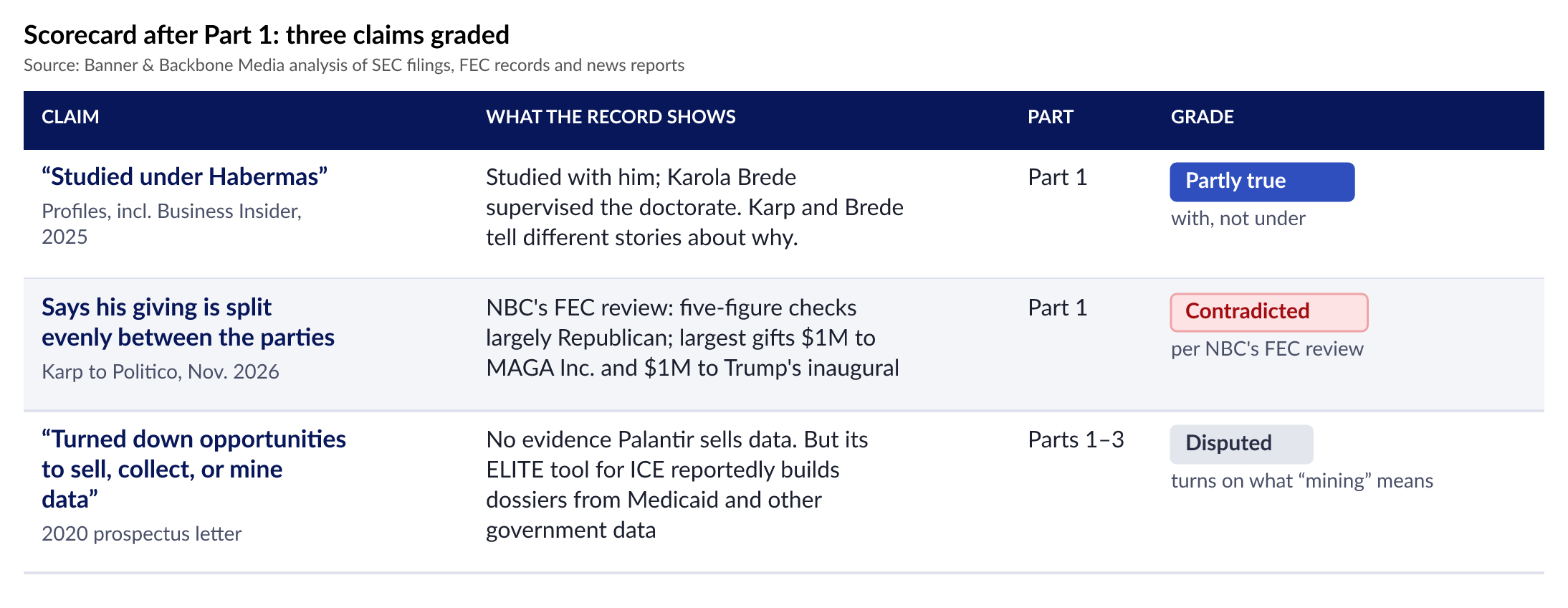
This series tests what Karp and Palantir say against the public record. Each part adds the claims it tests; this part grades three. Each row takes one claim, made by Karp or Palantir or repeated in profiles of him, and grades it. Supported means the record backs the claim. Partly true means part of it holds and part doesn’t. Contradicted means the record points the other way. Disputed means credible evidence cuts against the claim, but the answer turns on how you define its terms. Unproven means no public evidence shows the claim working in practice. Unverified means the record needed to check it isn’t public. I emailed Palantir questions about the claims in this series on Nov. 18, 2026, and asked for a response by Nov. 20. I followed up on Nov. 23 and asked for a response by 1 p.m. Eastern on Nov. 24. As of Nov. 23, Palantir had not responded. I’ll add its answer here if it replies, and update the grades if its answer or new records change the picture.
The Karp Files running scorecard after Part 1. Grades as of Nov. 18, 2026. Parts 2 and 3 add the claims they test. Sources for every row are listed below the image. — Source: Banner & Backbone Media analysis of SEC filings, FEC records and news reports
Scorecard sources:
Studied under Habermas (Partly true): [3][6][7] (Politico essay)
Giving split evenly between the parties (Contradicted): [32] (Politico Playbook)
Turned down selling or mining data (Disputed): [9] (SEC S-1; EFF). No evidence Palantir sells data; whether running analytics on a customer’s data counts as “mining” it is a matter of definition.
Our Read
The Habermas story is worth getting right because of what it shows about how Karp sells himself. “Studied under Habermas” makes Karp sound like a reluctant philosopher-king, a man of the democratic left who wandered into defense work. The record is more specific. By Karp’s own account, the great theorist of reasoned argument declined to keep supervising him. The dissertation he finished, under a sociologist at the Freud Institute, is about how aggression holds groups together and how a speaker can win a crowd through form rather than argument.
Seen that way, the dissertation reads like a description of the company Karp would go on to run. Palantir’s own language, “We have chosen sides,” “the side of the West,” and what Al Jazeera summarizes as a “moral debt,” does what Karp said jargon does: it acknowledges real dangers and offers a sense of belonging to the people who sign on [15]. Karp may not have planned it that way, but his own theory is a useful lens for reading his company’s sales pitch.
The shifting labels fit the same pattern. “Socialist,” progressive but not woke, an enemy of “woke pagan” politics, a “Democrat my whole life”: the content changes with the audience and the moment, yet the form stays constant. Each label tells the listener which side Karp is on this year, while his largest checks went to Trump’s side. People change, and Weinberger herself says she doesn’t criticize him for going through a political transformation [2]. But a defense contractor’s politics are not a private matter when the same company sells to whoever holds the government.
Karp’s best defense is that his substance hasn’t changed. Since at least the 2020 prospectus, he has argued that democracies need hard power and that tech’s elite owes something to the country that made it rich [9][10]. If the parties moved around him, his label changes might be honest bookkeeping rather than salesmanship.
My answer: you can grant him the consistency and still notice that the consistent part is the part that sells software. The question for the rest of this series is what that consistency has bought, for Palantir, for Karp and for the governments that run on his code.
Open questions
Karp quotes Habermas’s Aug. 10, 2000 letter but hasn’t published it in full. Would the full letter, or Brede’s own records, settle whether this was a rejection or a handoff?
Will the dissertation ever get a full English translation and a close reading by more than one scholar?
What did Palantir’s early In-Q-Tel and CIA contracts cover? None of the sources here describe that work.
Which version of Karp’s politics will Palantir present to the Democratic Congress taking power in January?
What you can do
Read the primary record for yourself. Moira Weigel’s essay walks through the dissertation [7], and Karp’s 2020 letter to investors opens Palantir’s prospectus (SEC S-1). Then watch which version of Karp shows up when the new Congress convenes in January, and ask your members of Congress where they stand on Palantir’s contracts.
Next, in Part 2, “Follow the Money”: how an intelligence-funded start, years of government contracts and a 2020 stock grant became billions in stock sales for Karp, and why the $11.1 billion in “compensation actually paid” isn’t cash.
Related reading
This Week in Palantalk: Who Controls Starshield, Palantir’s ‘Progressive’ Pivot & More
Palantalk | E59 - Updates on the Wars, the FAA, and a Progressive Palantir?
Sources
Wired — Alex Karp Said He’s a ‘Progressive.’ OK! Here’s Some Other Stuff He’s Said Recently. By Caroline Haskins, published Nov 12, 2026
Mother Jones — Alex Karp Wants to Be Friends With Democrats Again. By Sophie Hurwitz, published Nov 12, 2026
aol.com — The career rise of billionaire Alex Karp, Palantir’s outspoken CEO. By Avery Hartmans,Sarah Jackson, AOL, published Aug 6, 2025
fortune.com — Palantir’s CEO backs Harris and says that cofounder Peter Thiel’s support of Trump made it harder to get things done. By Marco Quiroz-Gutierrez, published Aug 19, 2024 (Subscription)
newstatesman.com — All your data belongs to us: the rise of Palantir. By James Vincent, published Nov 5, 2025, updated Nov 20, 2025 (Subscription)
legrandcontinent.eu — War der Palantir-Gründer Alexander Karp wirklich ein Schüler von Jürgen Habermas? Ein Gespräch mit seiner Dissertationsgutachterin Karola Brede - Der Grand Continent. By Matheo Malik, published Mar 18, 2026
boundary2.org — Moira Weigel — Palantir Goes to the Frankfurt School. published Jul 10, 2020, updated Apr 22, 2025
inquirer.com — Palantir waves the flag and embraces its U.S. government roots. By Lizette Chapman, published Aug 27, 2020 (Subscription)
in.marketscreener.com — Factbox: Palantir CEO excoriates Silicon Valley in letter ahead of market debut. By Reuters, published Aug 26, 2020
foxbusiness.com — Palantir CEO rips Silicon Valley’s values as the Peter Thiel backed company prepares IPO. By Thomas Barrabi, published Aug 26, 2020
fortune.com — Palantir’s Alex Karp promotes the A.I. military-industrial complex—but there are many reasons to be cautious. By David Meyer, published Jul 26, 2023 (Subscription)
defensescoop.com — Palantir CEO to those who don’t support U.S. military work: ‘Don’t work here’. By Billy Mitchell, published Jan 19, 2023
euronews.com — Ukraine is using Palantir’s software for ‘targeting,’ CEO says. published Feb 2, 2023
aljazeera.com — ‘Technofascism’: Critics accuse Palantir of pushing AI war doctrine. By Al Jazeera Staff, published Apr 20, 2026
foxbusiness.com — Billionaire tech CEO says he’s ‘not thrilled’ with direction of Dem Party, but ‘voting against Trump’. By Kyle Morris, published Jul 20, 2024
globalventuring.com — Case study: Farsighted Palantir sees data’s potential. published Mar 21, 2014 (Opinion)
cnbc.com — Alex Karp. By CNBC.com staff, published Oct 6, 2014 (Subscription)
unpopularfront.news — Habermas’s Bastards. By John Ganz, published Apr 1, 2026 (Subscription)
pbs.org — Influential German philosopher Jürgen Habermas dies at 96. published Mar 14, 2026
blog.kulturwissenschaften.de — Blog des KWI (Kulturwissenschaftliche Institut Essen). By Das Kulturwissenschaftliche Institut Essen (KWI)
nbcnews.com — New megadonors with major business before the government back Trump’s super PAC. By Ben Kamisar, published Jan 12, 2026
Chart data
The Karp Files running scorecard after Part 1. Grades as of Nov. 18, 2026. Parts 2 and 3 add the claims they test. Sources for every row are listed below the image. — data: Banner & Backbone Media analysis of SEC filings, FEC records and news reports
Compiled from 21 sources across 19 outlets. Source text as of Nov 23, 2026.
Banner & Backbone Authors’ Notes
Check out the new BroadBanner calendar and creator tools!

You being here shows that you have already begun the process of unfurling new Banners and forging new Backbones for a more progressive America. Please, take the time to become a paid, or free, subscriber to the Network — supporting us all and ensuring everyone in America can hear these messages.
The America we strive for — it is one where we willingly remember the teachings of our past, humbly learn from our failings, proudly celebrate our successes, and boldly lead the way into a future for all people.
Actions You Can Take
Call your public servants on important issues:
Join the efforts to de-flock the States:
Service members can get un-biased information on legal vs illegal orders:
Reach out on Signal: @TheOrdersProject.76
Reach out to the team if you are interested in volunteering time, supporting, and building these community driven platforms:
Submit feedback directly to: info@bannerandbackbone.com
Support and subscribe to Banner & Backbone!

Discussion about this post