



The Democratic sweep of the House and Senate puts the Trump administration’s plan to spend $1.5 trillion on defense in fiscal 2027 in doubt [1][3]. The same week, defense-tech firm Shield AI agreed to a $5.3 billion deal for a counter-drone radar maker [4][5], and the Justice Department (DOJ) official who led the federal push for state voter rolls resigned [10][11]. Overseas, the United Kingdom is reportedly keeping Palantir in its health service even as hospitals say they don’t use its platform [7][8].
The through-line: the money and data systems built over the past two years now face a Congress, courts and voters that can say no.
Will a Democratic Congress cap the Pentagon at $1 trillion?
What happened. The Pentagon’s $1.1 trillion base budget request is $242.4 billion, or 28%, more than the fiscal 2026 defense bill Congress passed [1]. The administration was also counting on a party-line reconciliation bill for $350 billion more [1]. That bill included nearly $54 billion for the Defense Autonomous Warfare Group, $17 billion for a Golden Dome missile-defense fund, and money to nearly double munitions spending to $76.3 billion [1].
Rep. Adam Smith, D-Wash., expected to chair the House Armed Services Committee, said he wants to hold total defense spending to $1 trillion in fiscal 2027 [1][3]. Analysts say reconciliation is likely dead once the new Congress is seated in January [1][3]. The government is running on a continuing resolution (CR), a stopgap funding bill, that expires Dec. 11 [1][3]. Capital Alpha Partners analyst Byron Callan put the odds of a shutdown after that at 50% [3].
The annual defense policy bill is stuck too. The House passed its version of the fiscal 2027 National Defense Authorization Act (NDAA), H.R. 8800, by 216 to 212 on July 22, and the Senate received it Sept. 14 [16]. The Senate’s own version, S. 4784, has not reached a floor vote: a July 14 bid to limit debate on taking it up failed 50 to 46, and the last recorded action was a July 27 motion to proceed [17]. The NDAA sets policy and authorizes spending levels, but “unlike an appropriations bill, the NDAA does not provide budget authority,” the Congressional Research Service explains [18]. The bills’ official summaries say both set policy on Pentagon acquisitions and on artificial intelligence [16][17]. TD Cowen analyst Roman Schweizer expects both the NDAA and defense appropriations to slip to early 2027 [3].
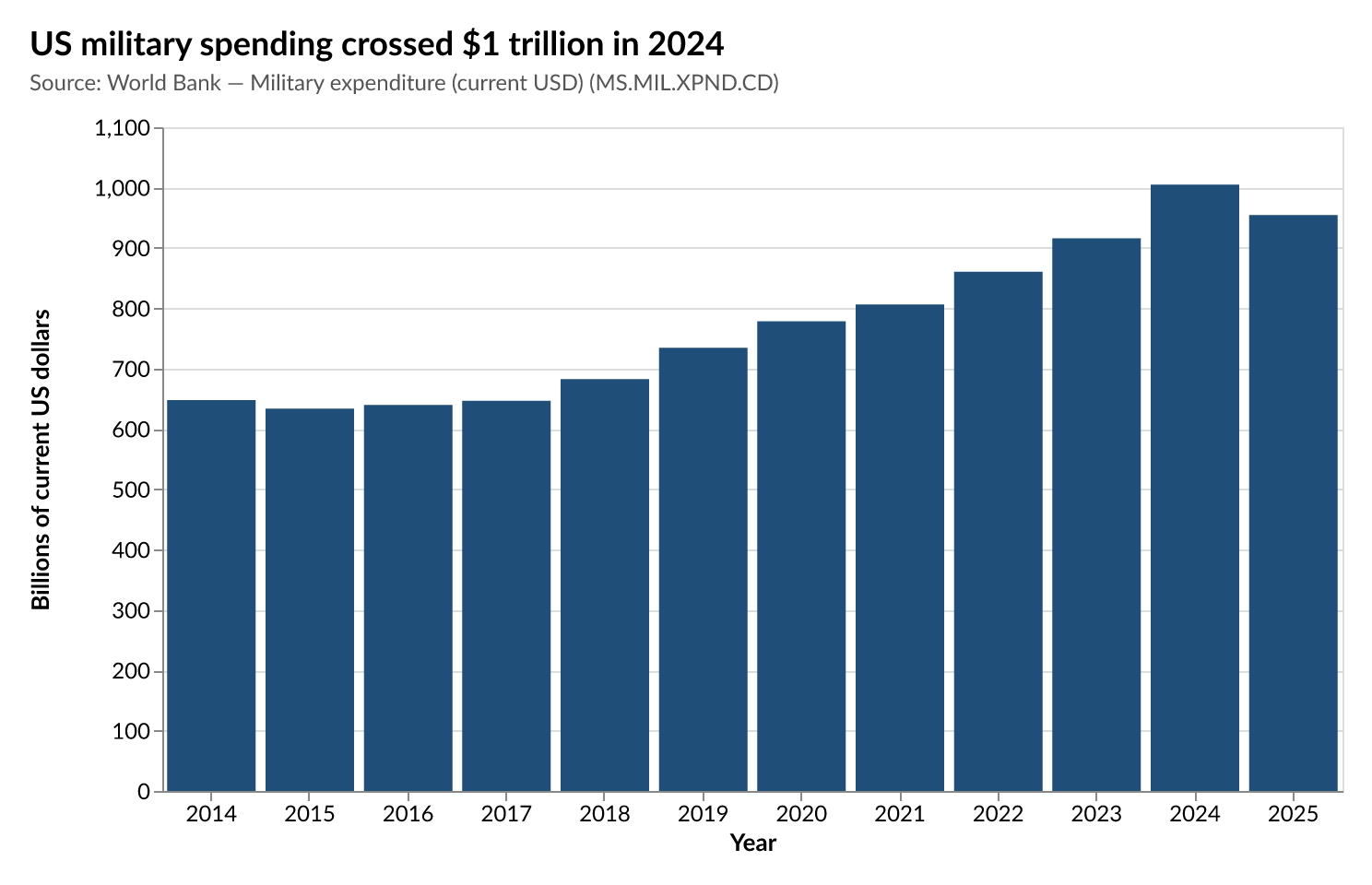
Why it matters. A $1.1 trillion budget instead of $1.5 trillion forces trade-offs, said Mark Cancian of the Center for Strategic and International Studies (CSIS) [2]. Callan wrote that the Pentagon’s Drone Dominance effort could be cut to a “fraction” of its $53.6 billion request [3]. A Democratic Congress is also expected to open anti-corruption probes, including into no-bid contracts and AI and drone policy, said Kristina Moore, a former congressional investigator [2].
The other side. Cancian said passing a roughly $1.1 trillion base budget is “quite doable” [2]. Defense One reported that counter-drone systems and autonomous gear are expected to keep bipartisan support, and Democrats are expected to fund munitions replenishment despite opposing the Iran war [1][2].
Open questions.
If Congress cuts the top line, do autonomy and drone programs get protected or squeezed?
Will oversight probes reach defense-tech startups with close White House ties, or only legacy primes?
We must push for the development of a more realistic and sustainable approach to our national security — one that does not require a defense budget in excess of $1 trillion or one paid for with draconian cuts to critical domestic programs. — Rep. Adam Smith, D-Wash. [3]
Is Shield AI’s $5.3 billion radar buy a bet on permanent drone war?
What happened. Shield AI agreed to acquire Echodyne, which makes counter-drone radars, in a deal valued at up to $5.3 billion [4][5]. Of that, $4.8 billion is paid at closing and up to $500 million depends on Echodyne hitting performance targets [4][5]. Shield is raising $2.5 billion alongside the deal, including a $1 billion Series H round at a $28.8 billion post-money valuation, $1 billion from Blackstone-managed funds and $500 million in JPMorgan-led debt [5].
In September, Echodyne won work from Joint Interagency Task Force 401 (JIATF-401), the Pentagon’s counter-drone task force [4]. Breaking Defense reported the selection without a dollar figure [4]. The deal is expected to close in early 2027 [4][5].
What the contract record shows. Outlets disagree on the size of that award: Washington Technology described it as a contract with a $250 million ceiling [5], while Military Times called it a $250 million contract over 36 months [6]. The Federal Procurement Data System (FPDS), the government’s official contract record, does not yet show a $250 million JIATF-401 award to Echodyne. Its largest direct Echodyne awards come from the State Department: $35.3 million committed for counter-drone radars, technical support and training, as of Feb. 18, 2026 [19], and $26.9 million committed for radar systems for Kyiv, as of Sept. 29, 2026 [20]. Its Army record is a $3.45 million purchase order for EchoShield radars signed in March 2026 [21]. FPDS can lag behind a contract’s signing, so a September award may simply not be listed yet; until it is, the record cannot settle whether $250 million is money committed or only a ceiling, and neither figure is money paid. Shield AI’s largest award on record is a Navy prototype project for runway-independent maritime strike, with $201.9 million committed against a $231.6 million ceiling as of Aug. 7, 2026 [22]. Its recent Coast Guard orders include $16 million committed for V-Bat drone services in Puerto Rico [23] and $8.4 million for a medium-range drone expansion in Guam [24].
Why it matters. Echodyne’s radars cue weapons including high-energy lasers and high-power microwave systems toward incoming drones [5]. Echodyne’s chief executive, Eben Frankenberg, told Defense News in July that demand for counter-drone radar is “red hot” and could grow tenfold by 2030 [6]. Shield’s acquisitions put sensors, autonomy software and drones under one company [4][6].
The other side. Shield says the deal answers customer demand for multi-mission systems and diversifies its revenue beyond software [4][5]. Frankenberg said the company’s radars help “protect people and infrastructure, secure borders, and ensure safe airspace operations” [4][6].
Open questions.
Does a radar that helps “secure borders” end up in domestic surveillance as well as on battlefields?
Is a $28.8 billion valuation a sign of real Pentagon production money, or of investor hype?
Palantir’s NHS contract survives. Who is using it?
What happened. The Guardian reported that 29 hospital trusts that NHS England lists as “realising benefits” from Palantir’s £330 million federated data platform (FDP) said the system is not live or they are not using its applications [7]. Days later, the Financial Times reported the UK government will extend the contract after a review concluded that triggering its break clause would be too disruptive, according to the Guardian [8]. Ministers instead plan a procurement for a UK alternative, with Palantir potentially replaced in two years [8].
Why it matters. Chi Onwurah, chair of the Commons science and technology committee, called for the government to use the 2027 break clause [7]. In Ukraine, Al Jazeera reported that a Palantir and Ministry of Defence platform launched in January, the Brave1 Dataroom, uses battlefield data to train military AI [9]. “We are paying with blood for data that someone else can convert into capital, international influence, and big money,” Ukrainian serviceman Valerii Markus wrote [9].
The other side. NHS England said nearly 140 trusts have reported benefits, and that its list includes trusts using the tools for back-office data work [7]. Palantir told Al Jazeera that “customers own and control their data” and that it “never uses or retains customer data for its own purposes” [9]. Elke Schwarz of Queen Mary University of London said the company does not need to own the data to benefit from it [9].
Open questions.
If hospitals aren’t using the platform, what exactly is the UK paying to keep?
Can any government build a “sovereign” alternative after years of dependence on one vendor?
The DOJ’s voter-roll crusade loses its architect
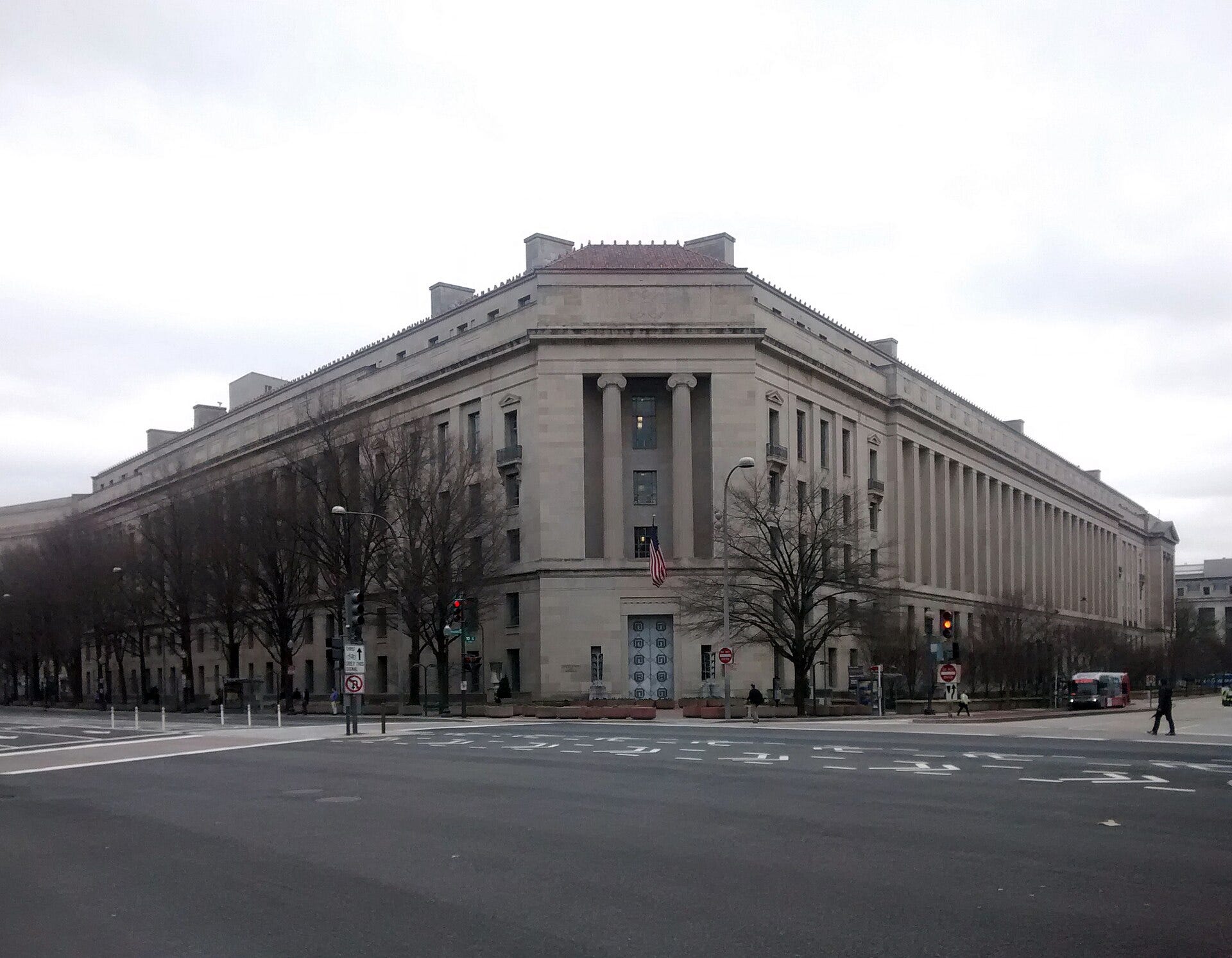
What happened. Harmeet Dhillon resigned as head of the DOJ’s Civil Rights Division, Attorney General Todd Blanche announced Nov. 5 [10][11]. Under Dhillon, the division demanded states’ unredacted voter-registration lists, including driver’s license numbers and partial Social Security numbers [10]. Democracy Docket reported the DOJ sued 30 states and Washington, D.C., and lost 27 straight district-court rulings without a single win [10].
Dhillon also oversaw work with the Department of Homeland Security (DHS) to build a national voter database from private voter information [10]. She told Fox News Digital she decided to leave weeks earlier and was asked by the White House to stay until after the election [11]. The San Francisco Standard reported hers is the first senior exit since Democrats won Congress [12].
Why it matters. The fight over who holds voter data does not end with one resignation: many of the losses are on appeal [10]. More than three-quarters of the division’s workforce at the start of Trump’s second term has left, the Associated Press reported [11]. Stacey Young, a former division attorney, said “Dhillon decimated it” [11].
The other side. Blanche said Dhillon “defended the civil liberties of every American and enforced the law without fear or favor” [11]. Some states have voluntarily provided voter information to the DOJ [10].
Open questions.
Who now holds the voter data states already handed over, and under what limits?
Will the next division chief drop the appeals or press them?
Westchester’s scanner failure: a vendor problem, not a plot
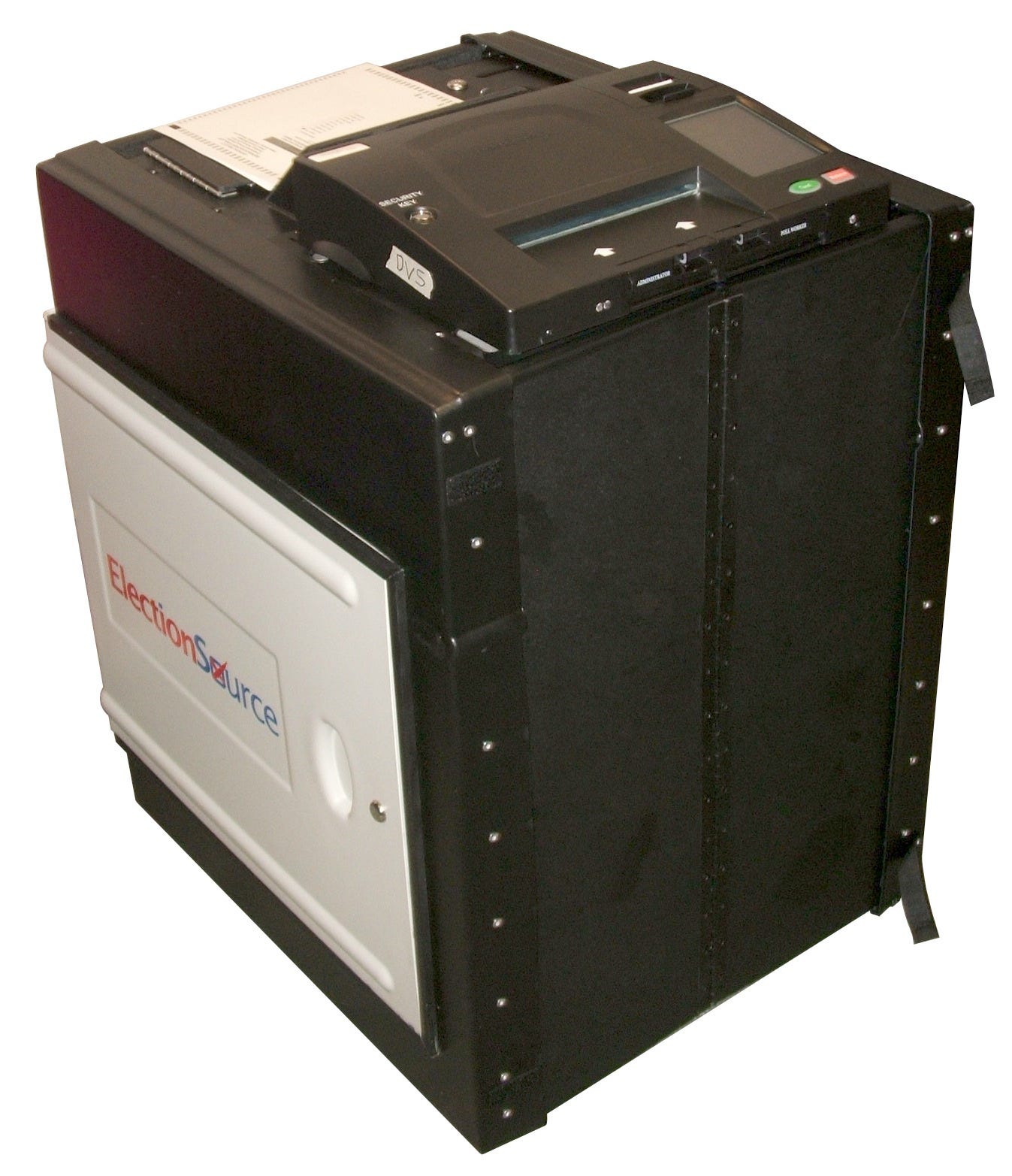
What happened. On Election Day, scanners in Westchester County, New York, could not scan as many as 250,000 ballots at 332 polling locations [13]. Voters kept voting on paper, and ballots went into sealed orange emergency bags to be counted later [13][14]. Al Jazeera reported the machines are made by Liberty Vote, formerly Dominion, and that officials blamed ballot paper that was too thick [15]. Democracy Docket reported it was not clear why the scanners rejected ballots [14].
Why it matters. Westchester is a large part of New York’s 17th Congressional District, one of the most closely watched House races [13][14]. Rep. Claudia Tenney, R-N.Y., posted that “The Democrats in NY will do anything and everything to cheat” [14]. County Executive Ken Jenkins called the failures “unacceptable” and promised a bipartisan review [14].
The other side. Voting nationwide went relatively smoothly, with only a handful of reported problems, the Guardian reported [13]. New York has set procedures for ballots scanners can’t read, including bipartisan oversight, and delayed counting under those rules is not evidence of fraud [14].
Open questions.
Who pays when a voting vendor’s equipment fails on Election Day?
Will the bipartisan review be made public?
Follow the Money
Palantir — Army · Contract / vehicle: Maven Smart System task order (W9128Z26FA001) · Committed: $1.12 billion · Ceiling: $1.14 billion · Dates (FPDS): First signed Nov. 2025; as of Aug. 6, 2026 · Source: [25]
Palantir — Navy · Contract / vehicle: ShipOS shipyard platform (N000242692101) · Committed: $366.4 million · Ceiling: $448.6 million · Dates (FPDS): First signed Nov. 2025; as of Apr. 21, 2026 · Source: [26]
Palantir — Army · Contract / vehicle: Maven Smart System licenses (W911QX24F0053) · Committed: $292.7 million · Ceiling: $328.9 million · Dates (FPDS): First signed June 2024; as of Sept. 15, 2025 · Source: [27]
Palantir — Air Force · Contract / vehicle: Headquarters Air Force data platform (FA880625FB011) · Committed: $78.5 million · Ceiling: $248.5 million · Dates (FPDS): First signed June 2025; as of June 26, 2026 · Source: [28]
Shield AI — Navy · Contract / vehicle: RIMES prototype project (N004212690013) · Committed: $201.9 million · Ceiling: $231.6 million · Dates (FPDS): First signed June 2026; as of Aug. 7, 2026 · Source: [22]
Shield AI — Coast Guard · Contract / vehicle: V-Bat services, Puerto Rico (70Z02326F93130005) · Committed: $16.0 million · Ceiling: $16.0 million · Dates (FPDS): First signed Mar. 2026; as of June 24, 2026 · Source: [23]
Shield AI — Coast Guard · Contract / vehicle: Drone expansion, Guam (70Z02326F93130008) · Committed: $8.4 million · Ceiling: $8.4 million · Dates (FPDS): Signed July 21, 2026 · Source: [24]
Echodyne — State Department · Contract / vehicle: Counter-drone radars (19AQMM25C1050) · Committed: $35.3 million · Ceiling: $35.3 million · Dates (FPDS): First signed July 2025; as of Feb. 18, 2026 · Source: [19]
Echodyne — State Department · Contract / vehicle: Kyiv radar systems (19AQMM26C0298) · Committed: $26.9 million · Ceiling: $26.9 million · Dates (FPDS): First signed Mar. 2026; as of Sept. 29, 2026 · Source: [20]
Echodyne — Army · Contract / vehicle: EchoShield radar purchase order (W912CH26PA005) · Committed: $3.45 million · Ceiling: $3.45 million · Dates (FPDS): First signed Mar. 2026; as of Mar. 27, 2026 · Source: [21]
Echodyne — JIATF-401 (Pentagon counter-drone task force) · Contract / vehicle: Counter-drone radars · Committed: Not in FPDS yet · Ceiling: $250 million reported · Dates (FPDS): September 2026 · Source: [5][6]
Palantir — NHS England · Contract / vehicle: Federated data platform · Committed: Not reported · Ceiling: £330 million reported (total contract value) · Dates (FPDS): Began 2024 · Source: [7]
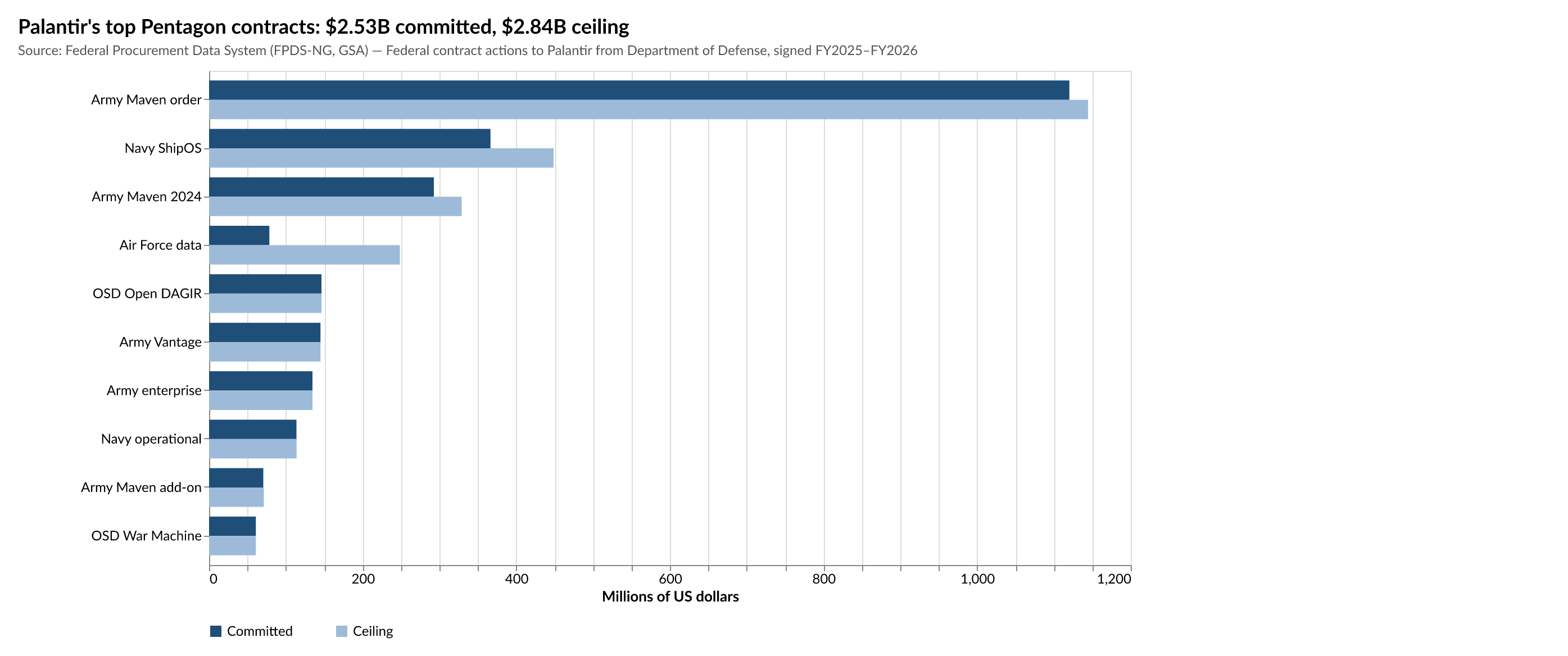
Rows citing a federal contract record come from FPDS, as of each contract’s latest recorded action. “Committed” is money obligated so far; “ceiling” is the base value plus all options, the most a contract could pay. Neither is money paid. Palantir’s ten largest Pentagon contracts with actions signed in fiscal 2025 and 2026 carry about $2.53 billion committed against $2.84 billion in ceilings, by each contract’s full record (chart below). That is a slice of the record, not Palantir’s total: FPDS lists 420 Palantir contract actions with the Pentagon in those two years. The NHS figure is different in kind: it is the reported value of Palantir’s U.K. health-data contract, not a U.S. federal record [7].
Watch Next Week
The lame-duck session: Republicans may make a last push on reconciliation before Democrats take control in January [3].
The continuing resolution funding the government expires Dec. 11 [1][3].
Whether the Senate takes up the House-passed NDAA, H.R. 8800, before the new Congress [16][17].
The UK’s planned procurement for a Palantir replacement, as reported by the FT [8].
Related Reading
This Week in Palantalk: ICE’s $100 Million Intelligence Network, the Voter-Data Fight & More
This Week in Palantalk: DOJ’s 20,000-Name Ballot List, Anduril’s Founder Breeds War Dogs & More
Read the sources below, and ask your representative where they stand on a $1 trillion defense cap.
Palantalk - where we talk tech, no fascism.
Sources
Defense One — Blue wave presages a defense-spending showdown. By Shaun McDougall, Forecast International, published Nov 6, 2026
Defense One — Tough choices, uncertainty, and scrutiny may lie ahead for defense contractors. By Lauren C. Williams, published Nov 8, 2026
Breaking Defense — Republicans have a ticking clock. What can they get done on defense?. By Valerie Insinna, published Nov 5, 2026
Breaking Defense — Shield AI acquires radar firm Echodyne in $5.3B deal. By Aaron Mehta, published Nov 5, 2026
washingtontechnology.com — Shield AI to acquire radar maker Echodyne in $5.3 billion deal. By Nick Wakeman, published Nov 5, 2026
militarytimes.com — Shield AI to acquire radar maker Echodyne to bust drones. By Zita Fletcher, published Nov 5, 2026
The Guardian — Palantir AI tech unused or little used by 29 NHS trusts said to be benefiting from it. By Robert Booth UK technology editor, published Nov 2, 2026
The Guardian — UK government to extend controversial Palantir NHS contract as it draws up plan for British alternative – as it happened. By Tom Ambrose, published Nov 6, 2026 (Live coverage)
Al Jazeera — Palantir harvests battlefield data that Ukraine pays for ‘with blood’. By Federica Marsi, published Nov 5, 2026, updated Nov 6, 2026
Democracy Docket — Harmeet Dhillon, architect of Trump’s failed voter roll crusade, resigns from Justice Department. By Matt Cohen, published Nov 5, 2026
kiro7.com — Harmeet Dhillon exits after radical overhaul of Justice Department’s Civil Rights Division. By ALANNA DURKIN RICHER and ERIC TUCKER, Associated Press, published Nov 5, 2026, updated Nov 7, 2026
sfstandard.com — Harmeet Dhillon, San Francisco’s anti-woke crusader, leaves the Trump administration. By George Kelly, Jonah Owen Lamb, published Nov 5, 2026 (Subscription)
The Guardian — US midterm voting goes smoothly with only a handful of issues nationwide. By Auzzy Byrdsell in New York, published Nov 4, 2026, updated Nov 5, 2026
Democracy Docket — ‘How the left steals elections’: False cheating claims fly as machine failure risks delayed results in key contest. By Yunior Rivas, published Nov 3, 2026
Al Jazeera — Where have there been technical issues so far during US midterm elections?. By Al Jazeera Staff, published Nov 3, 2026
Congress.gov — H.R. 8800: National Defense Authorization Act for Fiscal Year 2027. By Rep. Rogers, Mike D. [R-AL-3], published May 13, 2026, updated Oct 29, 2026
Congress.gov — S. 4784: National Defense Authorization Act for Fiscal Year 2027. By Sen. Wicker, Roger F. [R-MS], published Jun 15, 2026, updated Nov 4, 2026
Congressional Research Service (Congress.gov) — Defense Primer: The NDAA Process. By Brendan W. McGarry, Daniel M. Gettinger, Valerie Heitshusen, published Dec 4, 2025, updated Dec 5, 2025
Federal Procurement Data System (GSA) — Federal contract 19AQMM25C1050: ECHODYNE CORP, STATE, DEPARTMENT OF. By STATE, DEPARTMENT OF, published Jul 31, 2025, updated Feb 18, 2026
Federal Procurement Data System (GSA) — Federal contract 19AQMM26C0298: ECHODYNE CORP, STATE, DEPARTMENT OF. By STATE, DEPARTMENT OF, published Mar 5, 2026, updated Sep 29, 2026
Federal Procurement Data System (GSA) — Federal contract W912CH26PA005: ECHODYNE CORP, DEPT OF THE ARMY. By DEPT OF THE ARMY, published Mar 13, 2026, updated Mar 27, 2026
Federal Procurement Data System (GSA) — Federal contract N004212690013: SHIELD AI INC, DEPT OF THE NAVY. By DEPT OF THE NAVY, published Jun 1, 2026, updated Aug 7, 2026
Federal Procurement Data System (GSA) — Federal contract 70Z02326F93130005: SHIELD AI INC, U.S. COAST GUARD. By U.S. COAST GUARD, published Mar 2, 2026, updated Jun 24, 2026
Federal Procurement Data System (GSA) — Federal contract 70Z02326F93130008: SHIELD AI INC, U.S. COAST GUARD. By U.S. COAST GUARD, published Jul 21, 2026
Federal Procurement Data System (GSA) — Federal contract W9128Z26FA001: PALANTIR USG INC, DEPT OF THE ARMY. By DEPT OF THE ARMY, published Nov 21, 2025, updated Aug 6, 2026
Federal Procurement Data System (GSA) — Federal contract N000242692101: PALANTIR USG INC, DEPT OF THE NAVY. By DEPT OF THE NAVY, published Nov 21, 2025, updated Apr 21, 2026
Federal Procurement Data System (GSA) — Federal contract W911QX24F0053: PALANTIR USG INC, DEPT OF THE ARMY. By DEPT OF THE ARMY, published Jun 26, 2024, updated Sep 15, 2025
Federal Procurement Data System (GSA) — Federal contract FA880625FB011: PALANTIR USG INC, DEPT OF THE AIR FORCE. By DEPT OF THE AIR FORCE, published Jun 13, 2025, updated Jun 26, 2026
Chart data
US military expenditure, 2014–2025, in current (not inflation-adjusted) US dollars, as reported by the World Bank. This is actual spending, not the budget requests Congress is debating. — data: World Bank — Military expenditure (current USD) (MS.MIL.XPND.CD) (CC BY 4.0)
Committed = money obligated so far; ceiling = base value plus all options, the most each contract could pay. Neither is money actually paid. The ten largest Palantir contracts with the Department of Defense among the 50 largest FPDS actions signed in fiscal 2025–2026; each contract’s totals come from its full FPDS record as of its latest action (retrieved Nov. 9, 2026). Vendor matched by name (Palantir USG Inc.). — data: Federal Procurement Data System (FPDS-NG, GSA) — Federal contract actions to Palantir from Department of Defense, signed FY2025–FY2026 (Public domain)
Banner & Backbone Authors’ Notes
Check out the new BroadBanner network and affiliate calendar!

You being here shows that you have already begun the process of unfurling new Banners and forging new Backbones for a more progressive America. Please, take the time to become a paid, or free, subscriber to the Network — supporting us all and ensuring everyone in America can hear these messages.
The America we strive for — it is one where we willingly remember the teachings of our past, humbly learn from our failings, proudly celebrate our successes, and boldly lead the way into a future for all people.
Reach out to the team if you are interested in volunteering time, supporting, and building these community driven platforms:
Submit feedback directly to: info@bannerandbackbone.com
Support and subscribe to Banner & Backbone!

Compiled from 28 sources across 11 outlets. Source text as of Nov 9, 2026