This Week in Palantalk: Geneva's Empty Mandate, Palantir's CISA Pick & More
Three capitals, one question this week: who gets to check the software that governments run their wars, elections and health systems on.


In Geneva, the 128 parties to the Convention on Certain Conventional Weapons chose to “elaborate by consensus” on autonomous weapons rather than negotiate a binding treaty [1][2]. In Washington, Palantir’s chief information security officer, nominated to lead the agency that helps defend US elections, told senators he does not believe the Capitol was attacked on Jan. 6, 2021 [7][8]. In London, ministers said Palantir’s NHS data contract will end in 2029 and declined the break clause that could have ended it in 2027 [11][12].
Geneva Argued About Killer Robots. Who Checks the Software That Nominates the Targets?
What happened. Week-long talks in Geneva collapsed just before 5 a.m. on Nov. 21, 2026, after Russian objections blocked a negotiating mandate for a legally binding treaty on autonomous weapons [1]. The convention’s consensus rule forced the conference into a weaker text asking states “to elaborate by consensus” an instrument that may carry no legal obligations, with 2028 as the horizon [1][2]. More than 100 states had pushed for a new law; the United States, Russia and Israel opposed the binding route, and two EU diplomats told Politico that the UK, South Korea, Japan and Türkiye also resisted [1][2].
The definition under argument is narrow: the UN describes a lethal autonomous weapon system as one “capable of identifying, selecting, and engaging a target in a way that results in loss of life, without intervention by a human being operating the system” [2].
The AI already inside US targeting is not that system. Project Maven fuses drone, radar, satellite and text feeds into Palantir’s Maven Smart System to accelerate targeting [3]. In the 2019 Barisha strike The Intercept describes, Maven’s AI flagged a vehicle that human observers had missed, and the ground commander then called in the attack [3].
Google left the program in 2018 after staff protests and Palantir took the work [3]. This year the deputy secretary of defense told Pentagon leaders the Maven Smart System would be made a program of record, locking in its use across the military [3].
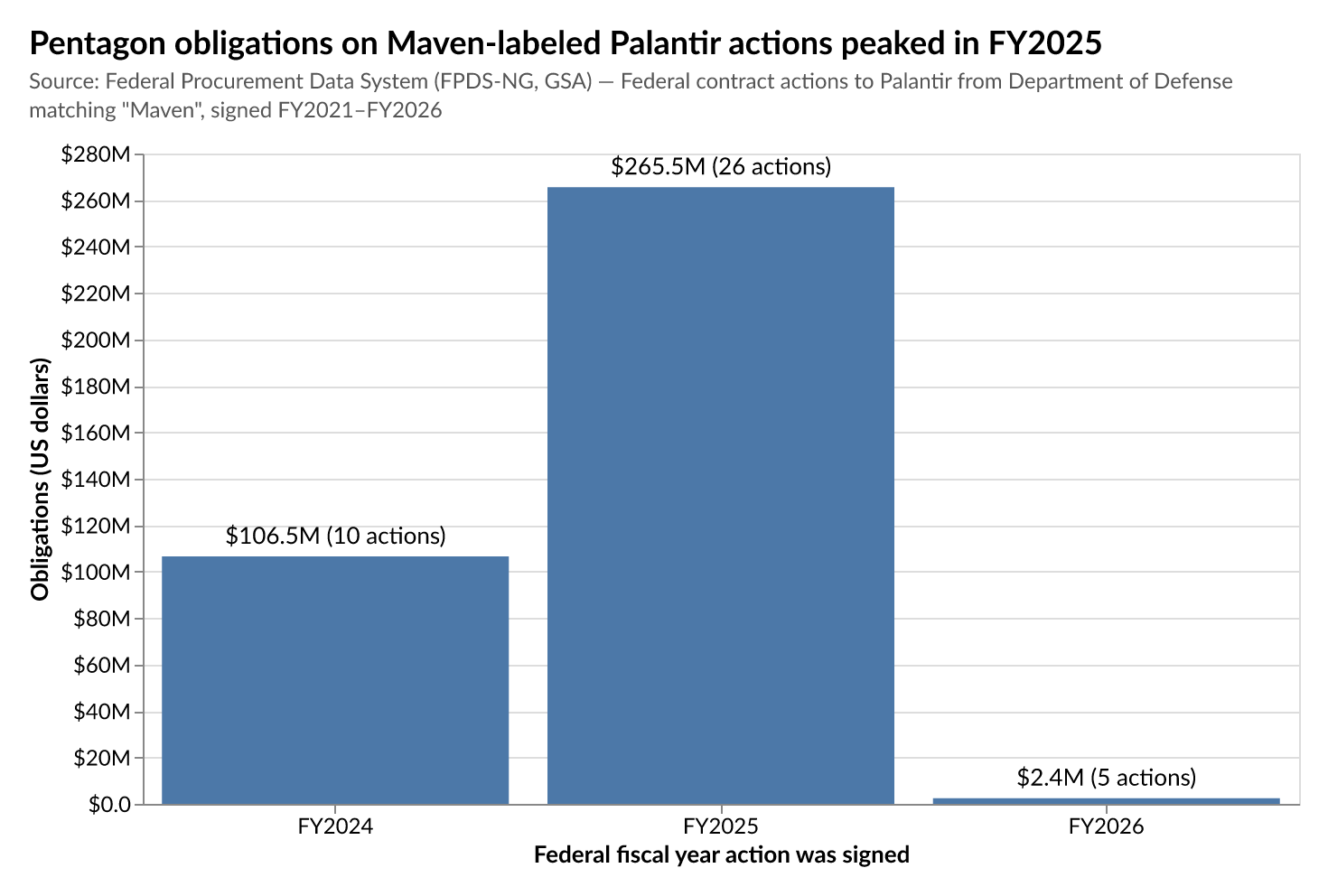
One Army task order for that system, W911QX24F0053, awarded in June 2024 under vehicle W911QX24D0012, had $292.7 million obligated against a $328.9 million ceiling as of Sept. 15, 2025 [17]. Obligated money is committed, not paid.
On Nov. 13, 2026, the Pentagon renamed its Chief Digital and Artificial Intelligence Office the Super Intelligence Office, a change the department said does not alter its mission; the office’s portfolio includes the Maven Smart System and the War Data Platform [5].
The evidence that AI targeting protects civilians is thin. Airwars documented 64 strikes attributed to US forces in Somalia in the two years before Maven arrived there in December 2017, and 153 in the two years after, with the documented civilian death toll rising from at least 25 to at least 79 [3]. Reporting the figures with Airwars, The Intercept named other causes in the same period: the designation of part of Somalia as an “area of active hostilities”, loosened targeting rules, strike approval lower down the chain of command and wider use of private contractors [3].
The hardest case on the record is still unresolved. More than 150 people, most of them schoolchildren aged 6 to 13, were killed when a missile destroyed the Shajareh Tayyebeh Elementary School in Minab, Iran, on Feb. 28, 2026, and the United States has neither acknowledged the strike nor credibly shown that another actor was responsible, legal scholars Diane Marie Amann and co-authors wrote in Just Security [4]. The UN’s Independent International Fact-Finding Mission on Iran found “reasonable grounds to believe” the strike was a war crime in its September 2026 report [4].
Whether AI played a part in choosing the school is not on the public record. Amann and her co-authors write that AI “appears to be at play in the Minab case” and call for prompt investigation “of the role played by AI” [4].
Relaying Bloomberg’s reporting, they describe a kill chain of “roughly three dozen people” and Pentagon investigators who found “high confidence throughout” it that the building was a military objective. They also write that some reported evidence may support an inference that one or more people in that chain knowingly relied on targeting data years out of date, and cite indications that commanders authorized the strike despite critical warnings in the targeting database [4]. The Pentagon has not released its review [4].
Why it matters. The duty sits with people, not software. Section 6.5.9.3 of the DoD Law of War Manual says the rules on conducting attacks “impose obligations on persons” and that “it is not the case that the law of war requires that a weapon determine whether its target is a military objective” [16]. The same section says the precautions a person must take “may be more significant when the person uses weapon systems with more sophisticated autonomous functions” [16].
Our read. Geneva spent 13 years arguing about a machine that selects and engages on its own [1]. Target-identification models like Maven fall outside that definition because it requires one system to both select and strike, The Intercept notes [3]. As these systems are described, they nominate and a person approves, which leaves the treaty that was not agreed silent on the one variable the law rests on: how much time and evidence a person has before approving a target.
So “a human is in the loop” answers nothing by itself. The questions are how long that human gets, what they see, and whether their reasoning survives in a form an inspector general, a court or a fact-finding mission can read afterward. A 2024 Maven exercise aimed at 1,000 targeting decisions an hour, or one every 72 seconds per operator [3]. Minab is where the record fails in public: a school is destroyed, a UN fact-finding mission finds reasonable grounds to believe it was a war crime, and nine months on nobody outside the Pentagon can say what role software played in the targeting decision.
The other side. The major military powers argue existing international humanitarian law is sufficient, and the United States said the need for human control had been discussed by Donald Trump and Xi Jinping at the Apec summit while declining to be bound by a new protocol [1][2]. On the manual’s own reading that position is coherent: the law binds commanders, and a rule written about weapons would not reach the staff process where this software sits [16]. Bonnie Docherty, a senior arms adviser at Human Rights Watch, said a treaty could be negotiated within 15 months and dismissed the US proposal of five years to settle a mandate [1].
Open questions.
How many minutes does a person get per AI-nominated target, and who keeps the record of that decision?
Should decision-support software fall under the Pentagon’s autonomy directive, or is it exempt by design?
There is no evidence that the introduction of AI reduced harm or made targeting more accurate. — Namir Shabibi, reporting for The Intercept with Airwars [3]
Palantir’s Security Chief Was Nominated to Defend US Elections. He Says Jan. 6 Was Not an Attack.
What happened. Michael LoSapio, Palantir’s chief information security officer and President Trump’s nominee to lead the Cybersecurity and Infrastructure Security Agency (CISA), appeared before the Senate Homeland Security and Governmental Affairs Committee on Nov. 19, 2026 [8]. Asked by Sen. Richard Blumenthal, D-Conn., whether the Capitol was attacked on Jan. 6, 2021, he first said he did not know, then said: “No, I don’t believe it was an attack” [8][10]. He added: “I wasn’t involved in politics” [8].
LoSapio also would not say who won the 2020 popular vote, telling Blumenthal, “I’m not going to answer the question about an election six years ago”, and said his only involvement that year was voting for Trump [8]. Joe Biden won both the popular vote and the Electoral College [8].
Sen. Thom Tillis, R-N.C., has placed a hold on the nomination, which he confirmed to HuffPost on Nov. 20, keeping LoSapio out of the package of nominees due for a vote next month [9]. Tillis told the Hill that whether a mob attacked the Capitol is “binary” [9]. Sen. Ron Wyden, D-Ore., also said he plans a hold, Defense One reported [8].
CISA has had no Senate-confirmed director for 22 months, since Jen Easterly left in January 2025 [10]. The agency has lost roughly a third of its workforce since Trump returned to office, and Sen. Elissa Slotkin, D-Mich., put the administration’s proposed budget about $385 million below its 2025 funding [8]. LoSapio said he could not assess the agency from outside government, and that “I don’t necessarily believe more money means more security” [8].
LoSapio has worked at Palantir for more than a decade and has never held a government role; the company donated $10 million to Trump’s White House ballroom project and holds billions of dollars in federal contracts, Mother Jones reported [7]. A Palantir spokesperson did not immediately return Defense One’s request for comment [8].
Why it matters. CISA is the federal agency that helps states find and mitigate cyber threats to election systems [10]. In 2020 it was among the federal agencies that called the election “the most secure in American history” and said there was “no evidence that any voting system deleted or lost votes, changed votes, or was in any way compromised” [9]. Trump fired its director, Chris Krebs, for publicly declaring the election secure, and in April 2025 signed a memorandum directing executive offices to address supposed “risks from Chris Krebs” [8][9].
In July, Homeland Security Secretary Markwayne Mullin threatened to keep withholding CISA election-security support from states unless they used a federal database to maintain their voter rolls, Democracy Docket reported [10]. A state that refuses loses the federal help it has used to find and fix cyber threats to its election systems, and Democracy Docket reports the administration has already largely dismantled the agency’s election work [10].
Our read. The job of this agency, at least once, was to tell a president something he did not want to hear, and the man fired for doing it is named in a presidential memorandum as a risk. A nominee who will not describe Jan. 6 as an attack, or name the 2020 winner, has answered the first question that mattered at that hearing.
The second problem drew little attention in the hearing coverage cited here: the agency defending election infrastructure would be run by the security chief of a company selling the government targeting and data software, and nothing in that coverage explains how that relationship gets walled off once he is inside.
The other side. The White House defended the pick, citing LoSapio’s technical experience and his work protecting Palantir against nation-state threats [8]. His written opening statement set four priorities, among them defending civilian federal agencies and supporting state and local governments, and some industry officials told Nextgov/FCW they welcomed the prospect of permanent leadership after nearly two years without it [8].
Open questions.
With the hold in place, who runs election-security support for states through 2027?
What separates a CISA director from his former employer’s federal business, in writing?
Britain Set a 2029 Exit From Palantir and Will Keep Paying Until Then
What happened. Health minister James Frith told MPs on Nov. 16, 2026 that Palantir’s role running the NHS federated data platform will end in 2029 [11]. The Department of Health and Social Care passed on a break clause that would have let it end the contract next spring and will keep it for two more years, to March 2029 [11]. NHS England awarded the contract in 2023, worth up to £330 million over seven years, so the new end date still falls before the full term would have run [12].
Frith called the two years “a bridge, not the destination” and said formal procurement for a replacement starts in the second half of 2027, a process expected to take 18 months [12].
Chi Onwurah, who chairs the Commons science and technology select committee, said her committee had “repeatedly called on the government to exercise the 2027 break clause” and that the decision not to was “deeply disappointing” [11]. Martin Wrigley, a Liberal Democrat MP, said ministers had “kicked the can down the road to March 2029” [11].
Many NHS trusts have declined to use the platform, and NHS England last week deleted a claim from its website that 137 trusts were benefiting from it after the Guardian reported that 29 used it never or rarely [11].
Why it matters. The platform links patient and hospital data across trusts and was designed to create a single point of access to patient data across NHS England, so the contract decides who holds the keys to health data for millions of NHS patients [12][13]. None of the reporting cited here says what a patient’s record on the platform contains or whether a patient can keep it off, and the independent review of the platform led by Imperial College London is not due to report until 2029 [12]. Patients do have one opening on the record: Frith said the requirements for the replacement will be drawn up from January “in collaboration with patients, the public, and NHS partners”, pharmaphorum reported [13].
Amnesty International, which called the decision “a victory for healthcare workers, patients and campaigners”, has pressed the government over Palantir’s acknowledged support for Israel’s military in “war-related missions” [11]. The Liberal Democrats have also pointed to the company’s work with US Immigration and Customs Enforcement [11].
Our read. This is a procurement decision written up as a political exit. The government conceded the principle, that depending on a single supplier is a problem, then kept that dependence for two more years, with no word on whether Palantir itself may bid for the replacement [13], although firms from outside the UK can [12].
The usage figure is the tell. A platform many trusts barely touch, and 29 never or rarely use, is not something anyone is locked into for clinical reasons; the lock-in is procurement and timetable, which is the same reason the break clause went unused.
The other side. Palantir welcomed the decision, called it “good news for patients and for the NHS”, and said it would invest more in the UK over the next two years, POLITICO reported [12]. Frith said the aim is to avoid “over-dependence” and being locked into any single technology, with open standards in the next tender [11][12]. Ben Coleman, a Labour member of the Commons health select committee, said ending reliance on one supplier must happen “without disrupting patient care” [11].
Open questions.
Will Palantir be allowed to bid in 2027?
Can a patient keep their record off the platform, and how would they know it is there?
What happens to the data, and to the models built on the platform, when it is replaced?
The Through-Line
Three decisions, one structure: a government runs something consequential on software it cannot fully inspect, bought from a company that answers to shareholders, and then decides who is allowed to look.
Geneva declined to write the rule. The Senate is weighing whether the man who secures one vendor should help secure the vote. Britain conceded the dependence and kept it two more years.
What would change the picture is a record: time stamps on target approvals, a written recusal that separates a CISA director from his former employer’s federal business, and a published account of what a health data platform holds and who can query it.
Palantalk made no requests for comment for this piece; the responses quoted above were given to the outlets cited.
What to Watch
Whether the fiscal 2027 National Defense Authorization Act reaches the president’s desk by Jan. 3, and whether it authorizes an Autonomous Warfare Command, the domestic side of the question Geneva left open. House Armed Services chair Mike Rogers said autonomy “is going to be here to stay” but a command for it is premature: “it’s just not going to happen in this year’s NDAA” [6].
The Senate’s December nominations package, which Tillis’s hold keeps LoSapio out of [9]. If one of your senators sits on the Homeland Security and Governmental Affairs Committee, tell their office where you stand on the hold.
The NHS requirements work with patients and partners starting in January, before the second-half-of-2027 tender [12][13].
Worth your 10 minutes before the next autonomy hearing: §6.5.9.3 of the DoD Law of War Manual is two paragraphs long and is the government’s own answer to who is responsible when software nominates a target [16].
Related Reading
This Week in Palantalk: A $1 Trillion Pentagon Fight, Shield AI’s $5.3 Billion Radar & More
Palantalk Talking Points: ICE’s Voter Files and Palantir, Anduril’s $2.9 Billion Sub Deal & More
Palantalk | E55 - The Latest On the New Forever War, The Surveillance Machine & More
Palantalk - where we talk tech, no fascism.
Sources
The Guardian — International UN talks on controlling use of autonomous weapons collapse. By Frances Mao in Geneva and Patrick Wintour, published Nov 21, 2026
Al Jazeera — Why have UN efforts to regulate ‘killer robots’ stalled?. By Al Jazeera Staff, published Nov 22, 2026
The Intercept — When the U.S. Military Implemented AI, Civilian Deaths Rose. By Namir Shabibi, published Nov 18, 2026
Just Security — The United States’ Missile Strike on Minab’s Shajareh Tayyebeh Elementary School Part II. By Diane Marie Amann, published Nov 18, 2026
Breaking Defense — Pentagon rebrands principal AI shop as ‘Super Intelligence Office’. By Mikayla Easley, published Nov 13, 2026
Breaking Defense — $350 billion reconciliation bill ‘not going to happen’: HASC chair. By Ashley Roque, published Nov 18, 2026
Mother Jones — Trump’s Pick to Run America’s Cyber Defense Agency Doesn’t Think January 6 Was an Attack. By Schuyler Mitchell, published Nov 19, 2026
Defense One — Trump’s CISA nominee denies Capitol was attacked on Jan. 6. By David DiMolfetta, published Nov 19, 2026
The Guardian — Republican senator blocks Trump cyber nominee over January 6 denial. By Robert Mackey, published Nov 20, 2026, updated Nov 22, 2026
Democracy Docket — Trump’s pick for key election security post denies Jan. 6 was ‘attack’ on U.S. Capitol. By Jacob Knutson, published Nov 19, 2026
The Guardian — Ministers to end Palantir’s contract with NHS in England in 2029. By Denis Campbell Health policy editor, published Nov 16, 2026, updated Nov 17, 2026
thenextweb.com — UK to end Palantir’s NHS data platform contract in 2029, not now. By Alina Maria Stan, published Nov 18, 2026
pharmaphorum.com — UK sets 2029 timeline to end Palantir’s NHS contract
DoD Office of General Counsel — Department of Defense Law of War Manual. Version: June 2015, updated July 2023. Sections cited: §6.5.9.3 (p. 391) (Official document)
Federal Procurement Data System (GSA) — Federal contract W911QX24F0053: PALANTIR USG INC, DEPT OF THE ARMY. By DEPT OF THE ARMY, published Jun 26, 2024, updated Sep 15, 2025
Chart data
Obligations on DoD contract actions to Palantir whose descriptions mention Maven, by federal fiscal year signed. Obligated money is committed, not paid. FY2026 (Oct. 2025–Sept. 2026) holds five small Army orders for Maven Smart System field support and site licenses. The drop may reflect how later actions are labeled rather than a fall in spending; FPDS does not say which. — data: Federal Procurement Data System (FPDS-NG, GSA) — Federal contract actions to Palantir from Department of Defense matching “Maven”, signed FY2021–FY2026 (Public domain)
Compiled from 15 sources across 12 outlets. Source text as of Nov 23, 2026.
Banner & Backbone Authors’ Notes
Check out the new BroadBanner calendar and creator tools!

You being here shows that you have already begun the process of unfurling new Banners and forging new Backbones for a more progressive America. Please, take the time to become a paid, or free, subscriber to the Network — supporting us all and ensuring everyone in America can hear these messages.
The America we strive for — it is one where we willingly remember the teachings of our past, humbly learn from our failings, proudly celebrate our successes, and boldly lead the way into a future for all people.
Actions You Can Take
Call your public servants on important issues:
Join the efforts to de-flock the States:
Service members can get un-biased information on legal vs illegal orders:
Reach out on Signal: @TheOrdersProject.76
Reach out to the team if you are interested in volunteering time, supporting, and building these community driven platforms:
Submit feedback directly to: info@bannerandbackbone.com
Support and subscribe to Banner & Backbone!

Discussion about this post