This Week in Palantalk: Who Controls Starshield, Palantir's 'Progressive' Pivot & More
Private systems are carrying public power, from an ally’s drone links to voter rolls, and no one wants to own the decisions.


Ukraine’s president said speed limits on SpaceX’s military satellite service returned this week, and no one in Washington has said who ordered them [1][4]. Palantir CEO Alex Karp called his company’s products “essentially progressive” two days after President Donald Trump nominated Palantir’s security chief to run the nation’s civilian cyber-defense agency [5][7]. In Mississippi and Georgia, commercial and activist-built data tools wrongly flagged eligible voters [9][10].
Meanwhile, an analysis in War on the Rocks argued that the midterms appear to have dealt a “final death blow” to the administration’s $1.45 trillion defense budget request, putting Trump’s Golden Dome missile shield in front of a Democratic Congress [12][13].
Who decides when Ukraine’s drones lose their signal?
What happened. Ukrainian President Volodymyr Zelenskyy said Nov. 12 that speed restrictions were back on Starshield, the military version of SpaceX’s Starlink service, in Russian-occupied parts of Ukraine [1]. He said the service stops working on Ukrainian military drones flying faster than 161 kilometers per hour, or 100 miles per hour [1]. Ukrainian officials reported a first round of restrictions about a month ago, and those limits were lifted by Oct. 24 [1].
Speaking in Kyiv, Zelenskyy said the limits had been in place for five days and appeared to be “political” rather than “technical” [4]. SpaceX told Ars Technica, “This is false. There has been no change” [1]. SpaceX has received multiple Pentagon contracts to give Ukraine access to Starshield [1].
Elon Musk, SpaceX’s CEO, has said “Starshield systems are owned and controlled by the US government” and that any limits “are decided by the US military and ultimately POTUS” [1]. Trump denied making the decision, Secretary of State Marco Rubio said the administration had “no foreknowledge,” and the Pentagon inspector general declined a request from senators to investigate who ordered the restrictions [1].
“These are not random errors, but systematic speed restrictions.” — Ukrainian President Volodymyr Zelenskyy [1]
Why it matters. Zelenskyy said the limits keep Ukraine’s interceptor drones from catching Russian jet-powered Shahed drones, which means more strikes get through [1][2]. On Nov. 15 he warned they could weaken defenses around Ukraine’s power grid before winter, the same day a Russian strike on an Odesa-region energy facility left about 41,000 customers without power [2][3]. Senior Ukrainian officials told the Financial Times they believed the limits were imposed to pressure Kyiv during peace talks with Russia, according to Ars Technica [1].
Our read. This is what it looks like when a weapon depends on a contractor’s network. Every party with a plausible hand on the switch, from the company to the White House, has denied flipping it, and the one office positioned to find out has declined to look. That leaves an ally’s air defense subject to a decision no one will own.
The deeper problem is accountability, not Musk. If the government controls Starshield, as Musk says, then a policy choice about a war is being made without a public decision. If it doesn’t, a private company can shape a battlefield. Neither answer fits how military power is supposed to work.
The other side. SpaceX says nothing has changed, and Starlink has reported technical problems rather than deliberate limits [1][3]. Zelenskyy himself said “there may be some further checks” before the cause is settled [4]. The case for U.S. control is also real: a government that pays for a military system has a legitimate interest in deciding how it is used.
Open questions.
If the U.S. government controls Starshield, which official signed off on the speed limits, and under what authority?
Should military contracts for communications services require a public record whenever a service to an ally is restricted?
Who investigates when the inspector general won’t?
Can Palantir be “essentially progressive” and run DHS’s data?
What happened. “I’ve been a Democrat my whole life,” Karp told Politico on Nov. 11, adding that “all of our products are essentially progressive” [5][6]. Wired noted that Karp gave $360,000 to a Biden-Harris joint fundraising committee in 2023 and $1 million to MAGA Inc. the next year [6]. On Palantir’s Nov. 2 earnings call, he said, “We are delighted that we can support the war fighter even more because we’re making so much money” [6].
On Nov. 9, Trump nominated Michael LoSapio, Palantir’s chief information security officer, to lead the Cybersecurity and Infrastructure Security Agency (CISA) [7]. CISA has had no Senate-confirmed director since Jen Easterly left in January 2025, and cuts have reduced its workforce by roughly a third since Trump returned to office [7]. If the Senate doesn’t confirm LoSapio before this Congress ends, Trump would have to renominate him for the incoming Democratic majority [7].
In the U.K., NHS England deleted a claim that 137 hospital trusts were benefiting from Palantir’s federated data platform after the Guardian found 29 of them were not using all or most of it [8]. Ministers are weighing whether to extend Palantir’s £330 million contract to 2029 [8].
Federal procurement records show the Department of Homeland Security (DHS) committed about $214.6 million to Palantir contracts in fiscal 2026, up from about $20.5 million in fiscal 2024.
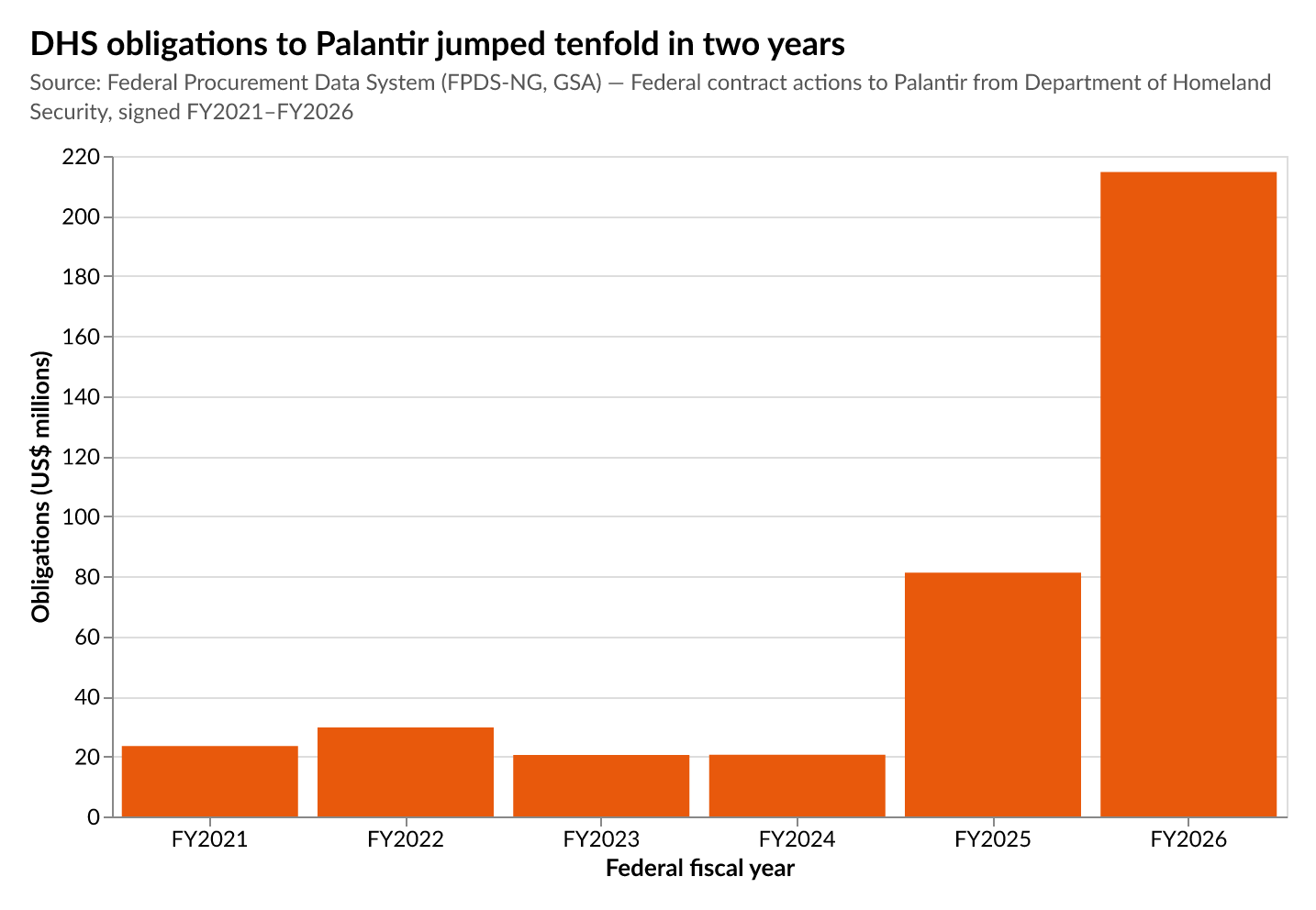
Why it matters. About half of Palantir’s revenue comes from government work, so the party in control of Congress matters to its bottom line [6]. Democratic lawmakers have questioned whether Palantir’s DHS work enables government surveillance of Americans, and Sen. Ron Wyden, D-Ore., said he plans to renew inquiries into the company when he chairs the Senate Finance Committee [7]. House Democrats have also pledged to investigate CISA’s cuts and changes to its election security work [7].
Our read. The timing tells the story. A company whose DHS business grew roughly tenfold in two years is rebranding for a Democratic Congress at the same moment one of its executives may take over the agency that protects election systems and critical infrastructure. That is the revolving door working in both directions: Palantir courts the incoming majority while one of its own is nominated to a top post in the current administration.
The NHS episode is a warning about the sales pitch. A government agency published Palantir’s reach as fact, and the list came down only after reporters checked it. Congress should expect the same gap between claims and use here.
The other side. Palantir has denied conducting or enabling mass surveillance [7]. The company has long argued it does not collect data but lets clients integrate data they already hold, defense reporter Sharon Weinberger said [5]. Karp argues the company’s products are “built to avoid war” through deterrence, and Palantir has said ending its NHS contract would be “putting politics above patients” [6][8].
Open questions.
Should a Palantir executive lead CISA while Palantir holds growing DHS contracts, and what recusals would be enough?
What will Wyden ask Palantir first, and can the Finance Committee compel answers?
What does “essentially progressive” mean for a company that builds tools for immigration enforcement?
What happens when bad data decides who can vote?
What happened. Mississippi Secretary of State Michael Watson, a Republican, threatened in a now-deleted post to sue Experian over data the state used to mark thousands of voters inactive [9]. In some cases, confirmation notices went to wrong addresses supplied by Experian, leaving voters unaware their status had changed [9]. More than 230,000 Mississippi voters were classified inactive before the election, though Watson said that figure built up over several years [9].
Experian said its product “was not designed or intended to validate voter records” [9]. Watson’s office said, “Mississippi was never told the data was only supplemental or that it was not intended for this use” [9]. The state signed a $50,000 contract with Experian in December 2024 that named voter roll maintenance as its purpose, and the U.S. Election Assistance Commission (EAC) had piloted the same product for that use [9].
In Forsyth County, Georgia, an election board member used a tool called ELLY to flag four voters as dead, and ProPublica found all four alive [10]. ELLY pulls from voter files, change-of-address records, tax documents, obituaries and property sites like Zillow, but lacks identifiers like Social Security numbers, which raises the risk of mismatches [10]. The board member, Max Clavijo, questioned more than 22,000 names on the county’s rolls, then said, “I did not make any explicit accusation that the information was 100% correct” [10].
Federally, the Justice Department (DOJ) lost its 28th straight case seeking states’ unredacted voter rolls, in Delaware, and won none [11].
Why it matters. Mississippi voters’ ballots were ultimately counted, but the wave of affidavit ballots caused confusion during a tight Senate race [9]. ELLY’s developer promised data from more than 3,000 counties to “citizen monitors” and Republican candidates trying to prove fraud [10].
Our read. The courts shut down DOJ’s attempt to centralize voter data, but the data problem didn’t go away. It moved to states and activists using commercial records that were never built to say who is eligible to vote. Credit-bureau and property data can tell you where someone might live; they can’t tell you who someone is.
The burden falls on voters. When a tool is wrong, the voter has to find out, prove they exist and cast a provisional ballot. When a tool is right, the official gets credit for clean rolls. That imbalance is what makes cheap data so tempting.
The other side. Accurate rolls are a legitimate goal, and federal officials thought commercial data could help: the EAC ran a pilot testing Experian’s product for list maintenance [9]. Watson says his new provider, IDI, compares address data from all three major credit bureaus and scores its reliability [9]. Clavijo said he was only trying “to clean the voter rolls” and inform the board [10].
Open questions.
Should states be allowed to change a voter’s status based on commercial data without a human check?
Who is liable when a vendor’s data wrongly marks a voter inactive: the state or the company?
Will Congress set rules for the data tools activists now use to challenge voters?
Will a Democratic Congress ground Golden Dome?
What happened. The midterms appear to have dealt a “final death blow” to the administration’s $1.45 trillion fiscal 2027 defense request, Matt Vallone wrote in War on the Rocks [12]. A path remains for the $1.1 trillion base budget, but the $350 billion reconciliation request has little chance, he wrote [12]. Congress has five scheduled work weeks left, and the current stopgap funding ends Dec. 11 [12][14].
Golden Dome’s first roughly $24 billion came through the party-line “One Big Beautiful Bill,” outside the normal budget process [13]. The administration projects the system will cost $185 billion over 10 years, while the Congressional Budget Office estimated about $1.2 trillion for a system meeting Trump’s executive order [13]. Seven House members of the all-Republican Golden Dome Caucus lost or did not run, including co-chair Rep. Jeff Crank, R-Colo. [13].
Rep. John Garamendi, D-Calif., the next-senior Democrat on the House subcommittee overseeing the program and in line to chair it, has called Golden Dome a “massive, extraordinarily expensive, and ultimately inadequate defensive system” [13]. Separately, 12 senators signed a letter opposing Section 219 of the Senate defense bill, which would create a U.S.-Israel Defense Technology Cooperation Initiative [14].
Why it matters. Money passed through reconciliation sits outside normal appropriations and is much harder for Congress to control, Vallone wrote [12]. Critics of Section 219 say it would create a new path for U.S.-funded defense work with Israel that avoids congressional oversight [14].
Our read. The common thread is control. Golden Dome and the proposed $350 billion add-on both relied on reconciliation, a route outside the normal appropriations process that Congress uses to write and police the defense budget. A Democratic Congress doesn’t have to kill the programs to change them; it only has to move the money back where it can be watched.
The cost spread is the tell. When official estimates range from $185 billion to $1.2 trillion for the same idea, the public isn’t being asked to fund a system. It is being asked to fund a promise.
The other side. Pentagon officials say the higher estimates ignore the military’s assumptions for low-cost launches and mass-produced satellites [13]. Much of what the administration calls Golden Dome was already in development or operating before Trump’s order [13]. Rep. Adam Smith, the ranking Democrat on the House Armed Services Committee, has called for a “more realistic and sustainable approach” to national security, not an end to it [14].
Open questions.
What survives of Golden Dome once it has to pass through regular appropriations?
Will Democrats use their filibuster leverage on the defense bill before Dec. 11, or wait for January?
Who gets the space-based interceptor contracts if the program is renamed and scaled back?
The Through-Line
Each of this week’s stories turns on a decision no one wants to own. A satellite link goes slow and every party denies touching it. A data vendor’s product marks voters inactive and the vendor says it was never meant for that. A defense contractor courts the new majority while its executive heads for a federal agency. In each case, private systems carry public power, and the public record trails behind.
What would change the picture: a named official accepting responsibility for the Starshield limits, a confirmation hearing that puts LoSapio’s Palantir ties on the record, and defense money moving back into the regular budget where it can be audited. Before Dec. 11, call your senators and ask where they stand on reconciliation defense money and Section 219.
Watch Next Week
Dec. 11: Current stopgap government funding expires, with the defense bill and Iran operations funding still pending [12][14].
Lame-duck Senate: LoSapio’s CISA nomination either moves before the 119th Congress ends or returns to Trump for renomination [7].
Ninth Circuit: DOJ’s voter-roll cases against Hawaii and Idaho remain on hold pending an appeals ruling [11].
U.K.: Ministers are weighing an extension of Palantir’s NHS contract to 2029 [8].
Related Reading
Banner Brief: Will Congress Renew Warrantless Spying Before Democrats Take Over?
This Week in Palantalk: ICE’s $100 Million Intelligence Network, the Voter-Data Fight & More
This Week in Palantalk: ICE’s voter files and Palantir, Anduril’s $2.9 billion sub deal & more
Palantalk - where we talk tech, no fascism.
Sources
Ars Technica — Ukraine says it can’t stop Russian strikes because Starshield is limited again. By Jon Brodkin, published Nov 12, 2026
PBS NewsHour — Zelenskyy says Starshield restrictions threaten Ukraine’s energy defenses ahead of winter. By Samya Kullab, Associated Press, published Nov 15, 2026
Al Jazeera — Starshield restrictions help Russia’s energy attacks on Ukraine: Zelenskyy. By Al Jazeera Staff, published Nov 15, 2026
The Guardian — Zelenskyy accuses SpaceX of lying about Starshield – and says US floated Donbas-for-Nato deal. By Luke Harding in Kyiv, published Nov 14, 2026
Mother Jones — Alex Karp Wants to Be Friends With Democrats Again. By Sophie Hurwitz, published Nov 12, 2026
Wired — Alex Karp Said He’s a ‘Progressive.’ OK! Here’s Some Other Stuff He’s Said Recently. By Caroline Haskins, published Nov 12, 2026
Defense One — Trump nominates Palantir security chief Michael LoSapio to lead CISA. By David DiMolfetta, published Nov 10, 2026
The Guardian — NHS England deletes ‘misleading’ claim 137 trusts benefiting from Palantir AI tools. By Robert Booth and Denis Campbell, published Nov 12, 2026, updated Nov 13, 2026
Democracy Docket — Mississippi Secretary of State crashes out over Experian voter data after election fiasco. By Yunior Rivas, published Nov 13, 2026
ProPublica — A Tool Built by Election Deniers Said These Voters Were Dead. We Found Them Alive.. By Doug Bock Clark, Max Blau, Misty Harris, published Nov 11, 2026
Democracy Docket — DOJ ends winless in voter roll crusade after final district court rejects bid to obtain Delaware’s list. By Andrew Childers, published Nov 10, 2026
War on the Rocks — RIP to the $1.45 Trillion FY2027 Defense Budget. By Matt Vallone, published Nov 16, 2026
Ars Technica — New Democratic Congress will likely strip the gilding from Trump’s Golden Dome. By Stephen Clark, published Nov 9, 2026, updated Nov 6, 2026
Al Jazeera — Will Democrats try to strip US-Israel initiative from Pentagon funding?. By Joseph Stepansky, published Nov 13, 2026
Chart data
Money DHS committed to Palantir contracts, by the federal fiscal year the action was signed (FY2026 ended Sept. 30, 2026). Obligations are committed funds, not money paid; a name match can include subsidiaries. — data: Federal Procurement Data System (FPDS-NG, GSA) — Federal contract actions to Palantir from Department of Homeland Security, signed FY2021–FY2026 (Public domain)
Compiled from 14 sources across 10 outlets. Source text as of Nov 16, 2026.
Banner & Backbone Authors’ Notes
Check out the new BroadBanner calendar and creator tools!

You being here shows that you have already begun the process of unfurling new Banners and forging new Backbones for a more progressive America. Please, take the time to become a paid, or free, subscriber to the Network — supporting us all and ensuring everyone in America can hear these messages.
The America we strive for — it is one where we willingly remember the teachings of our past, humbly learn from our failings, proudly celebrate our successes, and boldly lead the way into a future for all people.
Actions You Can Take
Call your public servants on important issues:
Join the efforts to de-flock the States:
Service members can get un-biased information on legal vs illegal orders:
Reach out on Signal: @TheOrdersProject.76
Reach out to the team if you are interested in volunteering time, supporting, and building these community driven platforms:
Submit feedback directly to: info@bannerandbackbone.com
Support and subscribe to Banner & Backbone!

Luv your new design and the color..
Vital information, thank you, Nick. I would like to know what former CISA director Chris Krebs thinks about Palantir's role in CISA and the government, but he doesn't seem to be saying much.