Banner Brief: The Pentagon Failed Its Ninth Audit. Why Does It Get $1.1 Trillion?
The Pentagon failed another audit the same day Senate appropriators proposed its biggest budget yet, and a newsroom is suing to learn what the Iran war has really cost in lives.


The Pentagon failed its ninth straight financial audit on Monday, according to an inspector general report [3]. Hours later, Senate appropriators released a defense spending bill of nearly $1.1 trillion for fiscal 2027, a historic figure [1]. The department still can’t show clean books across the board, and Congress is lining up its biggest check yet [1][2].
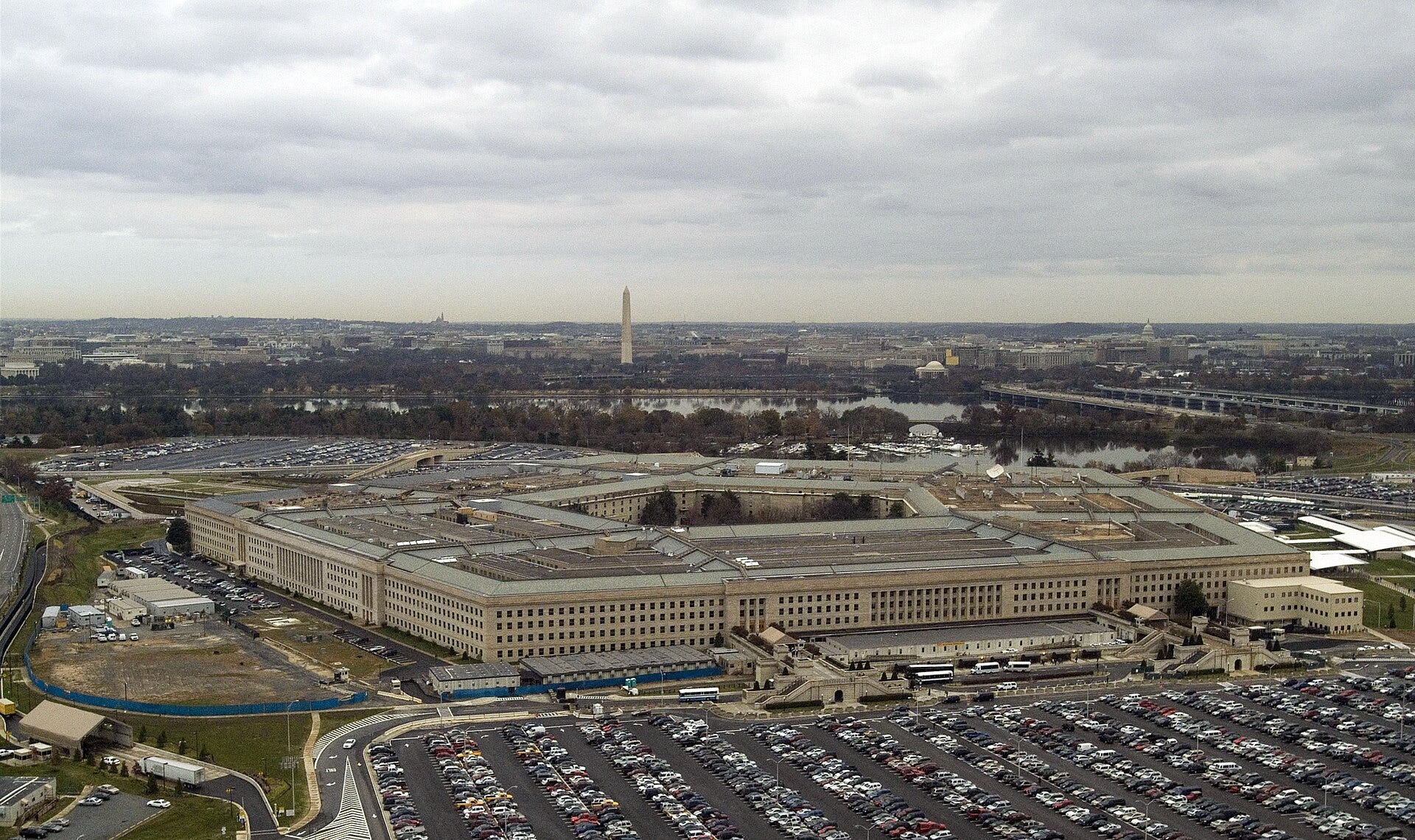
The Pentagon in Arlington, Virginia, in a 2005 Navy photo. The department that works here has now failed nine straight audits while Senate appropriators propose nearly $1.1 trillion for it in fiscal 2027. — Chief Photographer’s Mate Johnny Bivera / Wikimedia Commons · Public domain
What Happened
The audit examined $4.9 trillion in assets and $5.2 trillion in liabilities [2]. The Pentagon as a whole was first audited in 2018 and has never passed [3]. Congress gave it 10 years to get there, a deadline that falls in the fiscal year starting in October 2027 [3].
The outlets don’t agree on the scorecard. Reuters reported that 14 of 25 standalone reporting entities passed, up from 11, covering 56% of assets and 86% of liabilities [3]. Breaking Defense counted 12 clean opinions, with four more agencies, including the Defense Intelligence Agency, projected to be clean by February 2027 [2]. “For the first time ever, a majority of assets from the department are on clean opinions,” said Jules Hurst, the Pentagon comptroller and chief financial officer [3].
Hurst’s plan consolidates 25 separate audit opinions into eight and aims for a clean department-wide opinion in fiscal 2028 [3][4]. Fiscal 2026 is the last year the Defense Department’s inspector general oversees the audit; an independent public accounting firm takes over [4]. The data runs through the War Data Platform, the rebranded Advana, and Assistant Deputy Chief Financial Officer Shawn Lennon said the department brings that data “into Palantir Foundry to reconcile transactions” [4]. Reuters reported the department is also using artificial intelligence (AI) tools from Palantir and xAI to automate reconciliations [3].
The Senate bill falls short of the $1.5 trillion the Trump administration asked for, which was split into $1.15 trillion in the base budget and $350 billion through a reconciliation bill [1]. Appropriators instead moved nearly $69 billion of those reconciliation asks into regular discretionary funding [1]. That includes $9.4 billion for Golden Dome, $3 billion for the Defense Autonomous Warfare Group (DAWG) and $47.2 billion for munitions [1].
Congress has until Dec. 11, when the continuing resolution funding the government expires, to pass a bill, extend the stopgap or face a shutdown [1].
Why It Matters
Taxpayers are first in line. Reuters reported the Pentagon still runs on some 149 financial management systems, including technology built on 50-year-old computer code, while the administration seeks a record $1.5 trillion [3]. Hurst told DefenseScoop that over the next two years the department will not treat its “material weaknesses” as the main measure of progress, focusing instead on validating the data behind its statements [4].
Service members and readiness ride on the same bill. Senate appropriators included $1.7 billion to cover a projected fiscal 2027 fuel shortfall and $1.9 billion in flexible readiness funding for unfunded requirements [1]. The bulk of the munitions money, $40.6 billion, goes to multi-year missile contracts that are agreed in principle but not yet funded [1].
Our Read
I’m not shocked by a ninth failure. Anyone who has migrated data off a few hundred legacy systems knows a two-year clean-books promise is a bet, not a plan. What bothers me is the order of operations. The audit is supposed to be leverage: prove you can account for the money, then get more. If the historic number arrives either way, that leverage is gone.
The Senate move is also about who holds the purse. Folding $69 billion of one-time reconciliation asks into the regular budget keeps those decisions with appropriators instead of the authorizers, and it turns Golden Dome and autonomous warfare from a surge into a baseline. Baselines are much harder to cut than surges.
Then look at who’s checking the books. The layer that verifies whether Pentagon money moved correctly runs on software from a vendor the Pentagon pays. That isn’t proof of a conflict. It is a dependency. When an auditor’s evidence lives inside a contractor’s platform, oversight should be asking who can see that layer, who can change it and what happens to the audit trail if the contract ends.
The Other Side
Hurst argues the new strategy is exactly what will work this time. “That shift is what will put us on the path to achieving a clean, department-wide opinion in 2028,” he said [2]. He told DefenseScoop that fixing every legacy system in two years “is not feasible,” so pulling the data into one platform is the realistic path [4].
Senate appropriators say their bill gives “stable, sustainable, and predictable funding for critical capabilities across the Joint Force” [1]. Sen. Mitch McConnell, the defense appropriations subcommittee chair, said, “Deterring these threats is a project bigger than one-time surges of cash” [1]. On their own terms, both points hold up: you can’t audit data you can’t collect, and missile makers can’t sign multi-year deals on money that might not exist.
Is the Pentagon Hiding the Iran War’s Real Toll?
What happened. The Intercept and Freedom of the Press Foundation filed two lawsuits against the Defense Department [6]. The first, filed Friday in federal court in the Southern District of New York, seeks casualty records, briefings given to Defense Secretary Pete Hegseth and the war’s financial costs, after the Pentagon missed the legal deadline on five public records requests [7]. As of Nov. 9, the Pentagon’s casualty system listed 23 service members killed and 867 wounded since Feb. 28 [7]. Reporter Nick Turse has documented unexplained changes to that count, including the death of Maj. Sorffly Davius, which took more than six months to appear [6][7]. The second suit, filed Monday, seeks records on what a Central Command (CENTCOM) spokesperson called “a list of people to disregard” [6].
Our read. A casualty count isn’t a press release. It’s the most basic record a democracy keeps about a war fought in its name. If the number moves without explanation and the reporter asking about it gets frozen out, the public loses its ability to weigh what this war costs. Lawsuits under the Freedom of Information Act (FOIA) are slow, but they move the question from a press office to a judge.
The other side. CENTCOM has denied that it keeps a blacklist of journalists [6][7]. I could not find a Pentagon response to either lawsuit in the coverage so far [6][7].
Watch For
Dec. 11: the continuing resolution expires, and Congress must pass defense funding, extend the stopgap or face a shutdown [1].
February 2027: the Pentagon projects four more agencies will reach clean audit opinions [2].
The Pentagon’s response to The Intercept’s complaint in the Southern District of New York [7].
Call both of your senators’ offices this week and ask one question: will they vote for nearly $1.1 trillion before the Pentagon can pass an audit, and what will they demand in return?
Open questions: Who outside Palantir can inspect how Foundry reconciles the Pentagon’s transactions? What does the Pentagon’s internal casualty data show that its public tracker doesn’t?
Related Reading
This Week in Palantalk: A $1 Trillion Pentagon Fight, Shield AI’s $5.3 Billion Radar Bet & More
This Week in Palantalk: Who Controls Starshield, Palantir’s ‘Progressive’ Pivot & More
Banner Brief: Iran Says It Hit a U.S. Radar. CENTCOM Says No. What Now?
Sources
Breaking Defense — Senate appropriators unveil $1.1T Pentagon spending bill, folding in reconciliation priorities. By Ashley Roque, Michael Marrow and Carley Welch, published Nov 17, 2026
Breaking Defense — Pentagon fails 9th audit, asserts path towards clean books in 2028. By Ashley Roque, published Nov 16, 2026
yahoo.com — Pentagon fails ninth straight audit despite progress in organizing finances. By Mike Stone, published Nov 16, 2026
defensescoop.com — Major changes to Pentagon’s financial auditing strategy hinge on War Data Platform. By Brandi Vincent, published Nov 17, 2026
The Intercept — The Intercept Sues U.S. Military Over Iran Casualty Tally and Blacklist of Journalists. By Jonah Valdez, published Nov 16, 2026
commondreams.org — The Intercept Sues Pentagon Demanding ‘True’ Casualty Figures From Trump’s Iran War. By stephen-prager, published Nov 13, 2026, updated Nov 15, 2026
Compiled from 6 sources across 5 outlets. Source text as of Nov 17, 2026.
Discussion about this video